Leadership
Why Most "High-Performance Systems" Fail Before the First Olympic Cycle Begins
Most systems collapse not from poor talent but from misaligned strategy. Here's what federations get wrong when they chase medals too soon.
You've seen it happen.
A federation secures funding. Hires a new performance director. Brings in sports science support. Athletes train harder than ever.
Then the Olympic cycle begins.
And within 18 months, cracks appear. Coaches clash with science staff. Athletes lose trust. The board panics about medal targets. By year three, you're not building a system—you're managing chaos.
The truth is this: Most high-performance systems don't fail because of poor athletes or insufficient funding.
They fail because they were never truly aligned in the first place.
The Medal-First Mistake
Here's what typically happens:
A federation looks at the next Olympic cycle and asks, <b>"How many medals can we win?"</b>
Wrong question.
The right question is: <b>"Are we ready to build a system that can consistently produce excellence?"</b>
Research from Sport Ireland's Paris Cycle Review identifies a critical truth—successful high-performance systems require sustained investment and organisational maturity, not just short-term medal chasing.
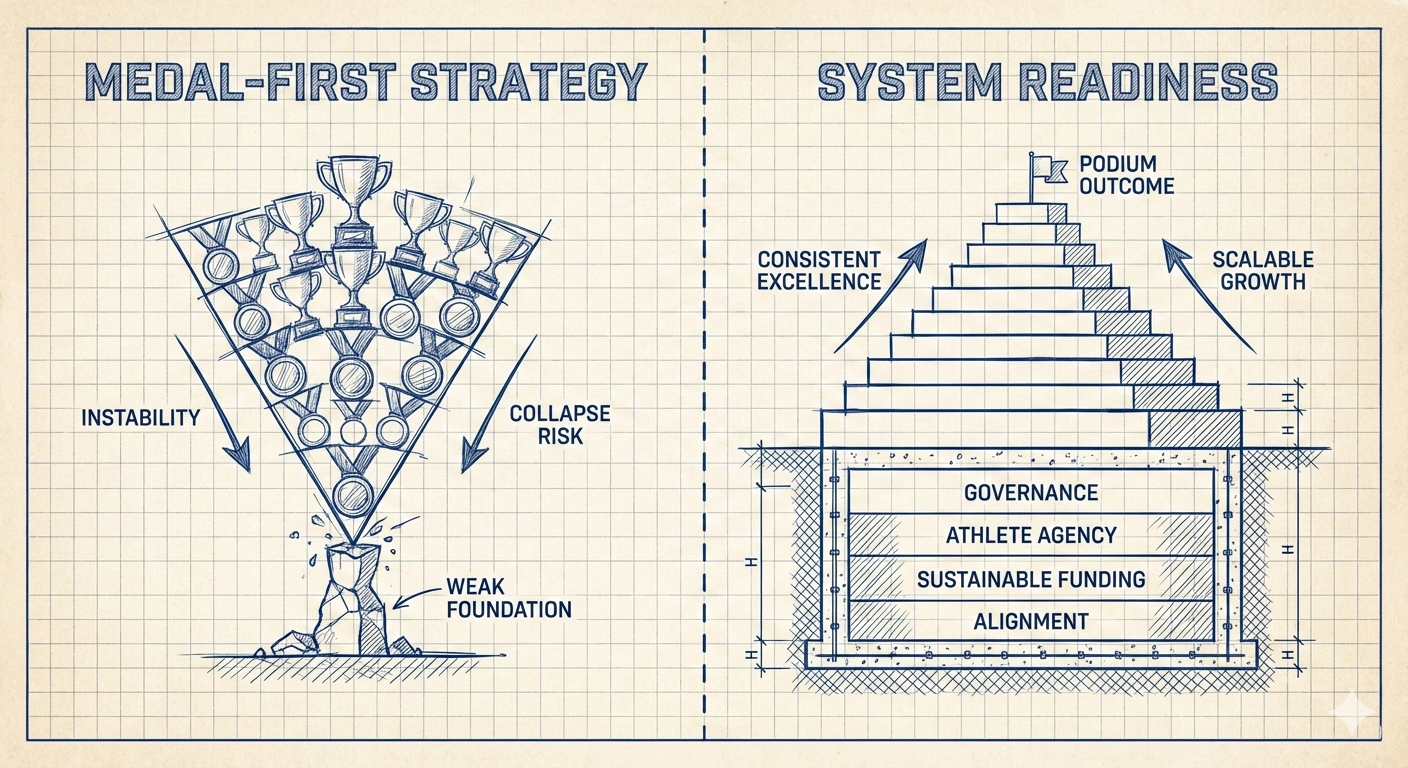
When you lead with medal targets before you've established the foundational systems, you create what I call <b> performance theatre </b>—it looks impressive on paper but collapses under competitive pressure.
Think about it.
You wouldn't build a skyscraper by starting with the penthouse. But that's exactly what happens when federations prioritise podium results over system readiness.
The Four Pillars That Actually Matter
After working with international federations and national governing bodies across multiple sports, I've identified four pillars that separate sustainable high-performance systems from those that implode:
1. Governance That Actually Governs
Most boards don't fail because they lack passion.
They fail because volunteer directors elected by grassroots clubs are suddenly managing million-pound budgets and making strategic decisions about elite performance—an area many are unfamiliar with.
Great systems elevate people. Poor systems constrain them.
When your governance structure can't differentiate between operational interference and strategic oversight, you don't have a board. You have a bottleneck.
<b>The fix?</b> Clear role definition. Strategic capability development. And honest conversations about whether your current governance model can handle high-performance demands.
2. Athlete-Centric or Athlete Theatre?
Everyone says they put athletes first.
But do they?
Research shows that whilst most sports governing bodies have institutionalised athlete participation, the overwhelming majority have not granted athletes formal decision-making power.
Athletes sit in meetings. They provide "input." But when critical decisions get made—about funding allocation, coaching appointments, competition selection—they're often sidelined.
Athlete-centric systems mean athletes have genuine voice, genuine agency, and genuine protection. Not just a seat at a table where decisions have already been made.
3. The Funding Reality No One Discusses
Let's talk money.
In smaller or growing sports, the uncomfortable truth is that many high-performance athletes are essentially self-funded or rely heavily on parental support, with organisational backing being inconsistent or non-existent.
And here's where the system breaks: Funding tends to be allocated to 'favoured' sports based on popular appeal or previous medal success—"no medals, no money".
So you're asking athletes to deliver world-class performances whilst they're running fundraising events and working side jobs just to train.
That's not a high-performance system.
That's a high-stress survival game.
Sustainable systems acknowledge this reality and build financial stability into the strategy—not as an afterthought.
4. Alignment Beats Ambition Every Time
The best part?
You don't need more resources to create alignment.
You need honesty.
Studies examining Olympic sport environments reveal that organisational functioning is often a distinguishing factor in achieving Olympic success, more so than individual coaching brilliance or raw athletic talent.
Alignment means:
<ul>
<li> Your board, performance director, coaches, and athletes understand the same priorities</li>
<li> Your funding model matches your strategic ambitions </li>
<li> Your organisational culture supports excellence without destroying wellbeing</li>
<li> Your systems are designed to scale as you grow</li>
</ul>
When misalignment exists—when the board wants medals, coaches want autonomy, athletes want support, and no one's talking to each other—you don't have a high-performance system.
You have competing agendas wearing the same tracksuit.
Why Systems Collapse Before They Start
The research on Olympic planning failures is sobering.
One study examining Australian Cycling's handlebar failure at Tokyo 2020 found that poor risk management, lack of adherence to rules, and concerning management safety attitudes all contributed to equipment failure under competitive pressure.
But the equipment wasn't the real failure.
The <i>system</i> was.
Because when you rush implementation, skip the boring work of building robust processes, and prioritise optics over operations, you create fragility masquerading as high performance.
High-performance sport is by nature an honest environment. Research on Olympic performance reviews emphasises that any lack of honesty during post-competition analysis will be exposed under pressure at the next Games.
<b>You can't fake readiness.</b>
The podium has a way of revealing exactly what your system is made of.
What Readiness Actually Looks Like
So what does a ready high-performance system look like?
<ol>
<li> <b>Clear governance</b> with strategic capacity, not just good intentions</li>
<li> <b>Athlete agency</b> embedded in decision-making, not just consultation</li>
<li> <b>Honest financial planning</b> that accounts for athlete realities</li>
<li> <b>Organisational alignment</b> where everyone rows in the same direction</li>
<li> <b>Scalable processes</b> that grow with success rather than crumble under it</li>
</ol>
The beauty of starting with readiness rather than results?
When you get the system right, <b>the medals follow</b>.
Not because you chased them.
Because you built an environment where excellence becomes inevitable.
Where Do You Stand?
Most federations don't know if they're ready.
They hope they are.
They assume good people and hard work will be enough.
But hope isn't a strategy. And hard work inside a broken system just produces faster failure.
<b>Here's my challenge to you:</b>
Before you set medal targets for LA 2028 or Brisbane 2032, ask yourself—do we actually have the organisational readiness to deliver?
<ul>
<li> Can our governance handle the pressure?</li>
<li> Do our athletes have real agency?</li>
<li> Is our funding model sustainable?</li>
<li> Are we truly aligned, or just pretending to be?</li>
</ul>
Because the federations that win don't just have talented athletes.
They have <i>resilient</i> systems that protect those athletes, enable coaching excellence, and create cultures where everyone can perform.
<b>Great systems elevate people.</b>
<b>Poor systems constrain them.</b>
Which are you building?
Ready to Find Out Where Your System Actually Stands?
Take the <b>HP Systems Readiness Scorecard</> and receive a personalised recommendation based on your organisation's current position.
Stop guessing. Start knowing.
Because the next Olympic cycle doesn't care about your good intentions.
It only cares whether you're <i>ready</i>.