Leadership
Who Really Decides When the Pressure's On? Decision Rights vs Decision Reality
You design a structure. You assign roles. You document who's responsible for what. You create RACI matrices—Responsible, Accountable, Consulted, Informed. You write it all down in board charters and delegation frameworks and job descriptions. And then, when pressure hits, none of it matters.
<h1>Who Really Decides When the Pressure's On? Decision Rights vs Decision Reality</h1>
<p>Your org chart says the Head Coach decides. Your board charter says the CEO owns it. Your selection policy says the panel has authority.</p>
<p>So why—when it really matters—does no one know who's actually making the call?</p>
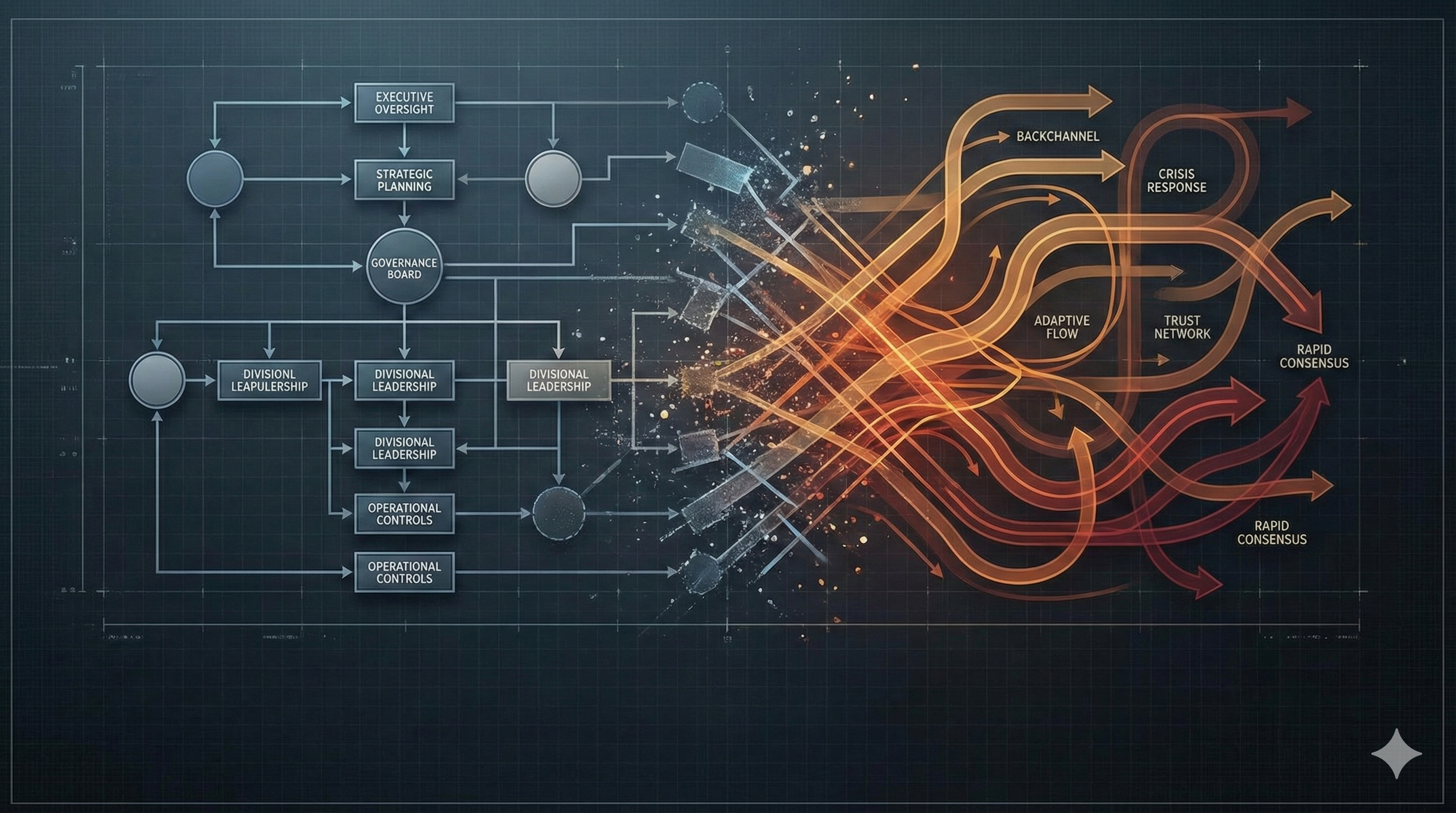
<p>The truth is, when pressure hits, decision authority doesn't follow your governance documents. It migrates. And if you don't know where it's going, you've got a system designed to fail at the worst possible moment.</p>
<h2>The Gap No One Talks About</h2>
<p><strong>Who should decide isn't who does decide.</strong></p>
<p>You've got role descriptions. RACI matrices. Delegation frameworks. Board policies that spell out accountability in careful language.</p>
<p>Sport governance frameworks repeat the mantra: boards govern, executives manage, high-performance staff deliver.<sup><a href="#ref1">1</a></sup> Clear structures solve accountability, right?</p>
<p>Wrong.</p>
<p>When a crisis hits—an athlete safeguarding concern, a last-minute selection dispute, a funding decision with 48 hours to respond, a media storm threatening your reputation—those tidy boxes on your org chart collapse.</p>
<p><strong>Pressure shifts power to whoever feels safest acting.</strong></p>
<p>And if no one feels safe? Decision authority goes underground. It migrates to informal channels, whispered conversations, and whoever has the most political capital to spend.</p>
<p>This pattern appears across high-stakes environments: when stress peaks, formal decision rights and actual decision behaviour diverge.<sup><a href="#ref2">2</a></sup> The org chart says one thing. Reality does another.</p>
<p>Sport organisations are no exception. Case studies from the Australian Sports Commission and governance reviews across National Governing Bodies confirm this pattern.<sup><a href="#ref3">3</a></sup></p>
<p>Why? While other sectors design authority structures for crisis, sport designs governance for peacetime—then acts shocked when it collapses under pressure.</p>
<h2>What Authority Migration Looks Like</h2>
<p>Let's get concrete.</p>
<p>You're a National Governing Body. Your selection policy clearly states: "The Selection Panel has final authority on team composition."</p>
<p>Three weeks before a major championship, an athlete posts something controversial on social media. Sponsors are nervous. The board wants them dropped. The coaching staff says it'll destroy team morale. The media is asking for comment.</p>
<p><strong>Who decides?</strong></p>
<p>The policy says the Selection Panel. But now you've got:</p>
<ul>
<li>Board members texting the CEO directly</li>
<li>Legal counsel flagging reputational risk</li>
<li>The Head Coach threatening to resign if the athlete stays</li>
<li>The Athletes' Commission demanding the process be honoured</li>
<li>A journalist asking for an on-record response by end of day</li>
</ul>
<p>The decision doesn't get made in the Selection Panel meeting. It gets made in a hallway conversation between the CEO and the Board Chair. Or in a frantic phone call at 11 PM. Or it doesn't get made at all—until external pressure forces someone's hand.</p>
<p><strong>Undefined decision rights default to instinct and influence.</strong></p>
<p>When speed, legitimacy, and self-preservation compete, formal authority crumbles. Research on high-performance sport governance shows a consistent pattern: when stakes rise, decision-making drifts from distributed expertise toward centralised, personality-driven choices that bypass formal accountability chains.<sup><a href="#ref4">4</a></sup></p>
<p>The decision migrates to whoever can act without getting blamed.</p>
<h2>The "Everyone's Accountable" Trap</h2>
<p>Most sport organisations respond to pressure by expanding accountability, not clarifying it.</p>
<p>"We all own performance."<br>
"The whole team is responsible."<br>
"Everyone's accountable for our culture."</p>
<p>This sounds collaborative. But <strong>when everyone's accountable, no one's accountable</strong>.<sup><a href="#ref5">5</a></sup></p>
<p>It's called responsibility diffusion. When a critical decision needs making—athlete medical clearance, controversial team selection, crisis communication—and multiple people share "collective ownership," what actually happens?</p>
<p>People hesitate. They seek more input. They wait for someone else to move first. They document more than they decide.</p>
<p>Why? Because if the decision goes wrong and you can't point to a clear owner, everyone gets blamed. But if you can show you "consulted widely" and "sought consensus," you're safer.</p>
<p>RACI matrices try to solve this by distinguishing "Responsible" (does the work) from "Accountable" (owns the outcome). But these tools often confuse who actually decides, when, and with what input—especially in fast-moving sport environments where decision cycles compress.<sup><a href="#ref6">6</a></sup></p>
<p>The result? Governance reviews focus on allocating blame after failure rather than examining how decision rights, information flows, and incentives combined under pressure.<sup><a href="#ref7">7</a></sup></p>
<h2>Why Sport Is Especially Vulnerable</h2>
<p>Most industries have time on their side. Even in healthcare, protocols are designed for high-stakes, time-compressed decisions with clear command structures.</p>
<p>Sport doesn't get that luxury.</p>
<p><strong>We operate in short cycles with long consequences.</strong></p>
<p>Selection decisions happen on tight deadlines. Athlete welfare issues demand immediate action. Funding announcements come with 72-hour windows. Media cycles move faster than board meetings.</p>
<p>Sport governance codes emphasise transparency, accountability, and separation of powers. But they pay less attention to how authority actually moves under real-time performance pressure.<sup><a href="#ref8">8</a></sup></p>
<p>Here's what makes sport uniquely vulnerable:</p>
<h3>Governance designed for stability, not crisis</h3>
<p>We write policies assuming calm deliberation, time for consultation, consensus as default, and monthly board meetings. High-performance sport systems are actually characterised by complexity, tight coupling, and rapid feedback loops—yet formal governance models assume stable conditions.<sup><a href="#ref9">9</a></sup></p>
<p>When pressure hits, the mismatch is catastrophic.</p>
<h3>The volunteer-board paradox</h3>
<p>Many sport organisations—especially smaller NGBs—rely on volunteer boards with expertise and passion but limited time and unclear authority when things move fast.</p>
<p>Guidance repeats that boards should "govern, not manage." Yet case studies show boards routinely step into high-performance decisions during crises precisely because decision-rights architecture was never designed for speed.<sup><a href="#ref10">10</a></sup></p>
<p>When a decision needs making now, who steps in? Usually the paid executive team—even when they technically report to the board.</p>
<h3>Funding precarity shifts power</h3>
<p>In smaller or financially vulnerable organisations, funding dependence effectively reassigns decision rights away from boards and performance leaders. When your primary funder can withdraw support based on performance metrics, governance decisions, or public controversy, who really decides your strategic direction?<sup><a href="#ref11">11</a></sup></p>
<p>The answer: whoever controls the money. That's rarely in your org chart.</p>
<h3>Scrutiny creates paralysis</h3>
<p>Every sport decision is visible. Every failure gets reviewed. Every mistake becomes a case study.</p>
<p>This creates blame anticipation—decision-makers altering behaviour not based on what's right, but on what will look defensible in retrospect.<sup><a href="#ref12">12</a></sup> Governance codes and state-backed reviews are increasing demands for transparency and accountability, raising the stakes: leaders must now demonstrate who decided what and on what basis, especially in welfare, discrimination, or corruption crises.<sup><a href="#ref13">13</a></sup></p>
<p>The result? Decision avoidance disguised as risk management.</p>
<p>"Let's get more input." "We should form a working group." "Maybe we need to escalate this to the board."</p>
<p>These sound collaborative. Often, they're just ways to diffuse risk.</p>
<h2>The Cost of the Gap</h2>
<p>What does it cost when formal authority and lived authority don't align?</p>
<p><strong>Decisions get made by proximity, not expertise.</strong> The person in the room makes the call—not the person with the best information or formal authority. Just whoever happens to be there when pressure peaks.</p>
<p><strong>Good people burn out.</strong> If you're the one who keeps stepping in because "someone has to decide," you carry weight the system should distribute. Eventually, you leave.</p>
<p><strong>Athletes lose trust.</strong> When decisions happen behind closed doors—outside the agreed process—athletes stop believing in the system. Even if the decision was right, the process was wrong. In sport, process legitimacy matters as much as outcome quality.</p>
<p><strong>Crises escalate instead of resolving.</strong> Unclear authority doesn't just slow decisions—it amplifies conflict. Multiple people start acting, or worse, no one does. You get decision paralysis or decision collision.</p>
<p><strong>Post-crisis reviews miss the real problem.</strong> Most reviews focus on culture, communication, or individual accountability. But the real issue? The system never clearly defined who decides what, when. Culture didn't fail. The system was never designed to succeed under pressure.</p>
<h2>What Safety-Critical Sectors Can Teach Sport</h2>
<p>Aviation, healthcare, nuclear power, and defence have faced this exact problem: complex, high-stakes environments where decisions compress under pressure and failure costs are catastrophic.</p>
<p>They've experimented with decision-rights architectures specifically designed for uncertainty—not assuming calm deliberation, but planning for crisis.<sup><a href="#ref14">14</a></sup></p>
<p>Key mechanisms worth exploring for sport contexts:</p>
<p><strong>Clear escalation protocols.</strong> Not "let's discuss this," but: "If X happens, Y person decides. If they're unavailable, Z person has backup authority."</p>
<p><strong>"Stop the line" authority.</strong> Certain roles—often junior ones—have explicit power to halt operations if they see a safety risk. No consultation required. No waiting for approval. This distributes decision authority to people closest to the risk.</p>
<p><strong>Rehearsed decision pathways.</strong> Running simulations, tabletop exercises, crisis drills—not to practice what to decide, but who decides under different scenarios.</p>
<p><strong>Functional redundancy.</strong> Instead of single points of accountability (which create bottlenecks and blame targets), building in overlapping expertise and backup decision-makers.</p>
<p><strong>Explicit decision traceability.</strong> Logging every critical decision: who made it, when, based on what information, with what authority. Not for blame, but for learning.</p>
<p>Whether these mechanisms transfer effectively to sport—with its unique incentive structures, time horizons, and stakeholder pressures—remains largely untested. But the principle holds: designing for crisis, not peacetime, changes everything.</p>
<h2>How to Spot the Signs</h2>
<p>You don't need a crisis to know if you've got a decision authority gap. Just pay attention.</p>
<p><strong>In the last 6 months, when something urgent came up:</strong></p>
<ul>
<li>Did the decision get made by the person your policies say should make it?</li>
<li>Or did it get escalated, bypassed, or made informally?</li>
<li>Could you trace the decision pathway afterward?</li>
</ul>
<p><strong>When someone asks "who decides?" do people confidently point to one role?</strong></p>
<ul>
<li>Or do they hesitate, list multiple people, or say "it depends"?</li>
</ul>
<p><strong>Do your decision-makers feel safe acting?</strong></p>
<ul>
<li>Or are they waiting for someone else to move first?</li>
<li>Seeking consensus when speed is critical?</li>
<li>Documenting more than deciding?</li>
</ul>
<p><strong>Do your escalation pathways actually work?</strong></p>
<ul>
<li>Or do people go around them?</li>
<li>Do crises land in weird places—like the CEO handling an athlete welfare issue that should sit with safeguarding?</li>
</ul>
<p><strong>Can you distinguish between "deciding," "advising," and "ratifying"?</strong></p>
<ul>
<li>Or does your RACI matrix lump them all together?</li>
</ul>
<p>If any of this feels familiar, you've got authority migration. And it's not a leadership problem. It's a design problem.</p>
<h2>The AI Governance Wake-Up Call</h2>
<p>Here's where this gets more complex—and where sport needs to start thinking ahead.</p>
<p>As sport organisations begin adopting AI-driven performance systems—selection algorithms, injury prediction models, automated scouting—the decision authority question will become exponentially harder.</p>
<p><strong>Who decides when the model says one thing and the coach says another?</strong></p>
<p>Is it the Head of Performance? The Data Scientist? The Selection Panel? The Board?</p>
<p>Governance debates around AI systems increasingly stress the need for frameworks that clarify decision rights when algorithms inform high-stakes choices.<sup><a href="#ref15">15</a></sup> Most sport organisations haven't designed this decision governance yet—they've deployed the tech without the accompanying authority architecture.</p>
<p>When an algorithm makes a controversial call, the authority gap you've been ignoring in human decisions will likely amplify in AI-assisted decisions. You'll have technical accountability (who built the model), operational authority (who applies the output), strategic oversight (who approved its use), legal liability (who's responsible if it's wrong), and athlete welfare concerns (who protects against biased outputs).</p>
<p>If those roles aren't clearly separated, your first AI controversy won't just be a performance issue—it'll expose systemic governance gaps.</p>
<p>Decision traceability—documenting who decides what, when, and why—becomes essential, not optional.<sup><a href="#ref16">16</a></sup></p>
<h2>Decision Rights as Performance Infrastructure</h2>
<p>Most organisations treat governance as compliance. A box to tick. A policy to write. A structure to maintain.</p>
<p>But clear decision rights aren't bureaucracy. They're performance infrastructure.</p>
<p>When your team knows:</p>
<ul>
<li><strong>Who decides</strong> (not who advises, not who ratifies—who decides)</li>
<li><strong>Under what conditions</strong> (routine vs crisis, strategic vs operational)</li>
<li><strong>What happens if that person's unavailable</strong> (backup authority, not escalation paralysis)</li>
</ul>
<p>…you get speed, legitimacy, and psychological safety simultaneously.</p>
<p>Athletes know the process will be honoured. Coaches know they can act. Boards know they're governing, not managing.</p>
<p>When pressure hits, the system doesn't collapse. It performs.</p>
<h2>Three Decisions That Need Clarity Now</h2>
<p>If you do nothing else, clarify decision ownership for these three scenarios:</p>
<h3>Selection and deselection</h3>
<p>Not just initial team selection. Mid-cycle changes. Injury replacements. Disciplinary removals. Performance-based cuts.</p>
<p>Who decides? Not "the panel advises and the board approves." That's avoidance.</p>
<p><strong>Who owns the decision?</strong></p>
<h3>Athlete welfare and safeguarding concerns</h3>
<p>When a concern is raised, who has authority to act immediately? Who can suspend, escalate, or investigate without needing board approval first?</p>
<p>This can't be ambiguous. Lives depend on it.</p>
<h3>Crisis communication and reputational risk</h3>
<p>Media calls at 9 PM asking for comment. Who's authorised to speak on behalf of the organisation? Who decides if you respond, stay silent, or escalate?</p>
<p>If the answer is "we'd need to discuss it," you're too slow.</p>
<p>Undefined decision rights default to instinct and influence. In a crisis, that's a recipe for failure.</p>
<h2>From Diagnosis to Design</h2>
<p><strong>Step 1: Map your current decision reality—not your policy documents.</strong></p>
<p>Pick three recent high-pressure decisions. Trace the pathway. Who was consulted? Who advised? Who actually made the call?</p>
<p>Compare that to what your governance documents say should have happened. The gap is your starting point.</p>
<p><strong>Step 2: Define decision ownership, not just accountability.</strong></p>
<p>Accountability is retrospective. Ownership is real-time.</p>
<p>For every critical decision type, name one role that owns it. Not a committee. Not "shared responsibility." One role.</p>
<p>Then define:</p>
<ul>
<li>What input they must consider</li>
<li>Who they must inform</li>
<li>When they escalate (not because they're unsure, but because it's outside their scope)</li>
</ul>
<p><strong>Step 3: Test it under pressure.</strong></p>
<p>Run a tabletop scenario. A last-minute selection change. A safeguarding allegation. A funding cut with 48 hours to respond.</p>
<p>Walk through who decides what, when. If people hesitate, if authority is unclear, if the pathway is "we'd need to discuss it"—you've found your gap.</p>
<p><strong>Step 4: Build decision speed into your design.</strong></p>
<p>Not every decision needs board approval. Not every decision needs consensus.</p>
<p>Define which decisions require deliberation and which require speed with legitimacy.</p>
<p>Sometimes the best governance move is to empower someone to act—and review later.</p>
<h2>Final Thought</h2>
<p>Governance isn't a compliance exercise. It's a performance system.</p>
<p>When pressure hits, your organisation won't rise to the level of your intentions. It'll default to the level of your design.</p>
<p>So the question isn't whether you have governance documents.</p>
<p>The question is: when it really matters, do your people know who decides?</p>
<p>If the answer is unclear, your system is already failing. You just haven't had the crisis yet that proves it.</p>
<h2>References</h2>
<ol>
<li id="ref1">Sports Governance Academy. (n.d.). <em>What is sports governance?</em> <a href="https://www.sportsgovernanceacademy.org.uk/resources/knowledge-base/introduction-to-sports-governance/what-is-sports-governance/" target="_blank">https://www.sportsgovernanceacademy.org.uk/resources/knowledge-base/introduction-to-sports-governance/what-is-sports-governance/</a></li>
<li id="ref2">Bigley, G. A., & Roberts, K. H. (2001). The incident command system: High-reliability organizing for complex and volatile task environments. <em>Academy of Management Journal</em>, 44(6), 1281-1299. <a href="https://doi.org/10.5465/3069401" target="_blank">https://doi.org/10.5465/3069401</a></li>
<li id="ref3">Australian Sports Commission. (n.d.). <em>Governance principles: Case studies</em>. <a href="https://www.ausport.gov.au/governance/principles/case-studies" target="_blank">https://www.ausport.gov.au/governance/principles/case-studies</a></li>
<li id="ref4">Good Corporation. (n.d.). <em>Sports governance: What does good look like and are sports governing bodies doomed to fail?</em> <a href="https://www.goodcorporation.com/business-ethics-debates/sports-governance-what-does-good-look-like-and-are-sports-governing-bodies-doomed-to-fail/" target="_blank">https://www.goodcorporation.com/business-ethics-debates/sports-governance-what-does-good-look-like-and-are-sports-governing-bodies-doomed-to-fail/</a></li>
<li id="ref5">WLS Pros. (n.d.). <em>RACI/RASCI matrix guide: Improve team clarity</em>. <a href="https://www.wlspros.ca/blog/raci-rasci-matrix-guide-improve-team-clarity/" target="_blank">https://www.wlspros.ca/blog/raci-rasci-matrix-guide-improve-team-clarity/</a></li>
<li id="ref6">LaunchNotes. (n.d.). <em>Accountable vs responsible in RACI: Understanding the key differences</em>. <a href="https://www.launchnotes.com/blog/accountable-vs-responsible-in-raci-understanding-the-key-differences" target="_blank">https://www.launchnotes.com/blog/accountable-vs-responsible-in-raci-understanding-the-key-differences</a></li>
<li id="ref7">Good Corporation. (n.d.). <em>Sports governance</em>.</li>
<li id="ref8">Good Corporation. (n.d.). <em>Sports governance</em>.</li>
<li id="ref9">Renn, O. (2008). Risk governance: Coping with uncertainty in a complex world. <em>European Journal of International Law</em>, 18(3), 523-527. <a href="https://academic.oup.com/ejil/article/18/3/523/363613" target="_blank">https://academic.oup.com/ejil/article/18/3/523/363613</a></li>
<li id="ref10">Australian Sports Commission. (n.d.). <em>Governance principles</em>.</li>
<li id="ref11">Loughborough University. (n.d.). <em>PhD opportunity: Governance in British basketball</em>. <a href="https://www.lboro.ac.uk/study/postgraduate/research-degrees/phd-opportunities/governance-british-basketball/" target="_blank">https://www.lboro.ac.uk/study/postgraduate/research-degrees/phd-opportunities/governance-british-basketball/</a></li>
<li id="ref12">Hood, C. (2011). <em>The Blame Game: Spin, Bureaucracy, and Self-Preservation in Government</em>. Princeton University Press.</li>
<li id="ref13">Good Corporation. (n.d.). <em>Sports governance</em>.</li>
<li id="ref14">Weick, K. E., & Sutcliffe, K. M. (2007). <em>Managing the Unexpected: Resilient Performance in an Age of Uncertainty</em> (2nd ed.). Jossey-Bass.</li>
<li id="ref15">Zhang, Y., et al. (2024). Complexity and resilience in AI governance systems. <em>PMC</em>, 12171231. <a href="https://pmc.ncbi.nlm.nih.gov/articles/PMC12171231/" target="_blank">https://pmc.ncbi.nlm.nih.gov/articles/PMC12171231/</a></li>
<li id="ref16">Gasser, U., & Almeida, V. A. F. (2017). A layered model for AI governance. <em>IEEE Internet Computing</em>, 21(6), 58-62. <a href="https://doi.org/10.1109/MIC.2017.4180835" target="_blank">https://doi.org/10.1109/MIC.2017.4180835</a></li>
</ol>