High Performance
How Performance Debt Accumulates Across Olympic Cycles
The article is sets up why the "cycle" (Olympic or Quadrennial Championship Cycle") has never been interrogated as an incentive structure, only celebrated as a planning discipline.
<!-- ARTICLE BODY -->
<main class="article-wrap">
<!-- INTRO -->
<div class="intro-block">
<p>When a high-performance system fails at a major championship, the instinct is to ask what went wrong in the final year. The selection process. The coaching appointments. The funding allocation. Those questions are not wrong. They are just late.</p>
<p>The conditions that produce failure at a Games are typically not created in the Games cycle. They are created across the two or three cycles that preceded it. The final cycle is where the debt is paid. The earlier cycles are where it was borrowed.</p>
<p>Understanding that distinction matters because it changes what a board, a funding body, or a performance director should actually be monitoring. Not just whether the programme is hitting its current targets. But whether the decisions being made today are creating liabilities that will land on the next leadership team, the next Games, or the next funding review.</p>
<p class="intro-bridge">The Olympic and championship cycle is the standard unit of planning in high-performance sport. It is widely regarded as a strength of the system — a discipline mechanism, a forcing function. It is also, less visibly, a structure that makes certain decisions easier to defer than to confront.</p>
</div>
<!-- SECTION 1 -->
<div class="section">
<div class="section-heading">
<h2>Where This Comes From</h2>
</div>
<p>The technical debt concept, developed in software engineering and first described by Ward Cunningham in the early 1990s, refers to the cost of design shortcuts taken for short-term reasons. Those shortcuts are not always irrational. They are often deliberate trade-offs made under time pressure. The debt becomes a problem not at the moment of the shortcut, but later, when the deferred design work must be done under worse conditions.</p>
<p>The same pattern appears in organisational systems. When a decision is deferred because the timing is inconvenient, or because the short-term cost of addressing it exceeds the apparent short-term cost of leaving it alone, the decision does not disappear. The problem continues to compound. The structural conditions that made it difficult to address remain in place. And the eventual cost of resolution, when resolution can no longer be avoided, is higher than it would have been earlier.</p>
<p>In high-performance sport, the Olympic cycle creates specific, predictable conditions under which this kind of deferral is not only possible but structurally encouraged. That is not an argument against the cycle. It is an argument for understanding its incentive effects honestly.</p>
</div>
<!-- SECTION 2 -->
<div class="section">
<div class="section-heading">
<h2>Cycles Create Incentive Structures, Not Just Planning Horizons</h2>
</div>
<p>A four-year funding cycle tied to Games performance creates a particular kind of accountability. Organisations are measured primarily against one output, at one point in time, on a four-year rhythm.</p>
<p>That accountability structure has real benefits. It focuses effort. It creates clear performance expectations. It provides a framework for resource allocation.</p>
<p>It also creates a set of incentives that deserve more scrutiny than they typically receive.</p>
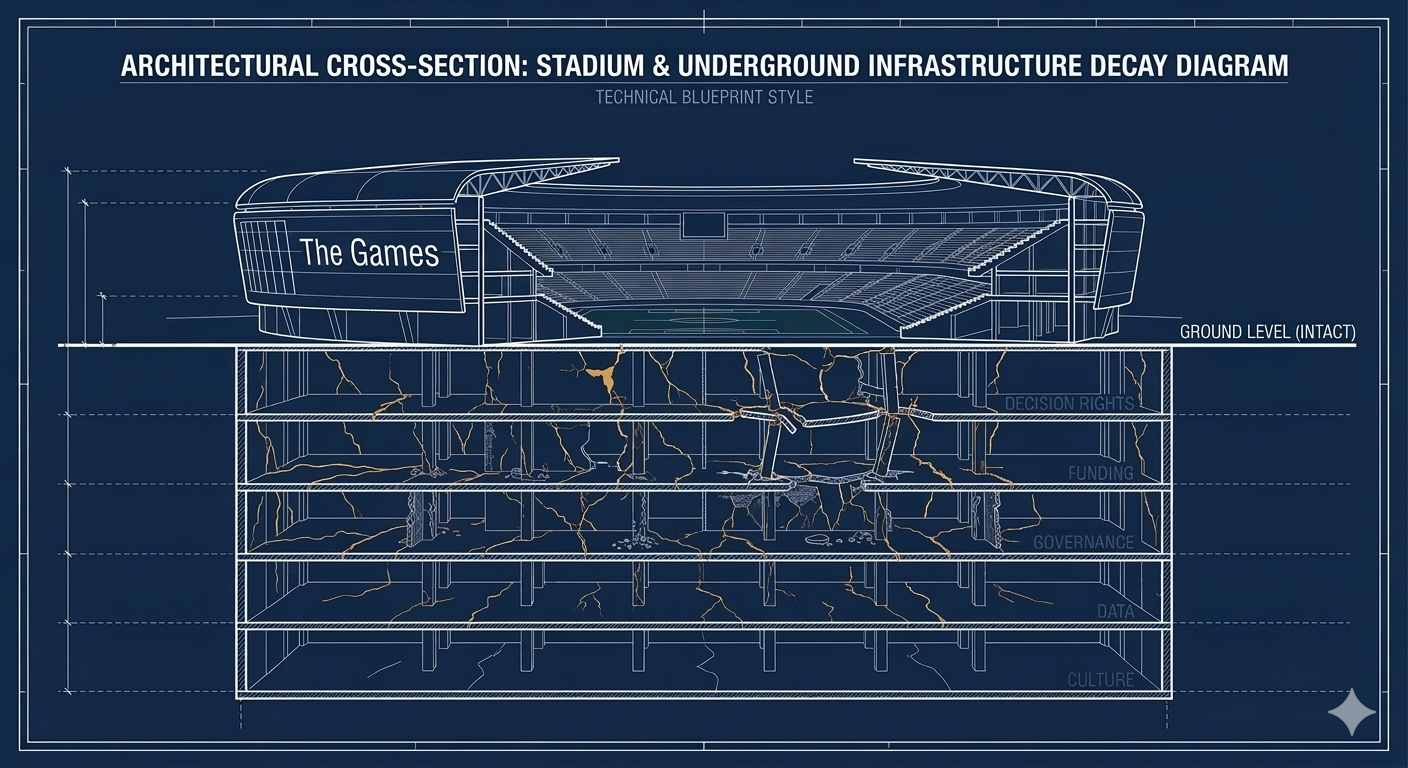
<p>When accountability is assessed primarily at the end of the cycle, decisions made in the middle of the cycle can accumulate without triggering visible cost. Governance ambiguities that emerge in year two do not produce measurable consequences until year four, if then. Decision authority that drifts informally during mid-cycle stability does not register as a design failure until a high-stakes moment exposes it. Cultural dynamics that develop across eighteen months of low scrutiny do not appear on a board risk register.</p>
<p>The cycle does not cause these things to happen. But it creates conditions under which they can happen, and remain unaddressed, for longer than would be possible in a system with more frequent, consequential checkpoints.</p>
</div>
<!-- SECTION 3 -->
<div class="section">
<div class="section-heading">
<h2>Where Debt Accumulates</h2>
</div>
<p>The Olympic cycle can usefully be mapped across three phases, each with different debt-generation characteristics. This is a proposed analytical structure, not a universal rule. But in practice, the behavioural patterns across these phases are consistent enough to be worth naming.</p>
<div class="phase-block">
<span class="phase-label">Phase 1</span>
<div class="phase-title">Post-Games Reset</div>
<p>The period immediately following a major Games is, in structural terms, the highest-value window in the cycle for addressing design problems. Scrutiny is active. Reviews are underway. Leadership may be in transition. Funding decisions are pending. There is political will to make changes, at least briefly.</p>
<p>This window is also frequently wasted. The organisation is managing the emotional and operational aftermath of a Games. Leadership bandwidth is constrained. External reviews have their own timelines. And the temptation is strong to focus on what the review calls for rather than on a more systematic audit of underlying design conditions.</p>
<p>Governance debt that could be addressed here — clarifying decision authority, resolving accountability ambiguities, redesigning escalation pathways — is often deferred in favour of more visible structural changes.</p>
</div>
<div class="phase-block">
<span class="phase-label">Phase 2</span>
<div class="phase-title">Mid-Cycle Stability</div>
<p>The middle of the cycle — roughly the eighteen to twenty-four months between the post-Games review and pre-Games compression — is where accumulation is least visible and therefore most likely to go unaddressed. Scrutiny from the post-Games review period has eased. The urgency of the pre-Games window has not yet arrived. The organisation is operating, broadly, as designed.</p>
<p>This is the phase where informal adaptations bed in. A key individual begins carrying decision authority that is not formally assigned to them. A governance ambiguity that would take six months to resolve properly is managed around. A cultural dynamic that should be surfaced through a formal feedback mechanism is absorbed by a small group of people who know how to navigate it.</p>
<p>These adaptations are not always damaging. Often they are genuine examples of professional skill. The problem is not the adaptation itself. The problem is that the adaptation substitutes for the structural fix, and the structural fix never happens. The informal system becomes load-bearing. And when it fails, or when the person carrying it exits, there is nothing underneath it.</p>
</div>
<div class="phase-block">
<span class="phase-label">Phase 3</span>
<div class="phase-title">Pre-Games Compression</div>
<p>In the final twelve to eighteen months before a major Games, organisations move into a mode characterised by risk reduction, stability, and execution focus. This is rational. The Games is not the moment to redesign governance structures or test new decision frameworks.</p>
<p>The problem is that this phase also freezes the system. Design problems that were deferred through Phase 2 cannot be addressed in Phase 3 without introducing the very instability that Phase 3 is designed to prevent. So they are carried into the Games. And through to Phase 1 of the next cycle, where the pattern begins again.</p>
</div>
</div>
<!-- SECTION 4 -->
<div class="section">
<div class="section-heading">
<h2>Why It Gets Worse Across Cycles</h2>
</div>
<p>Organisations can often carry modest structural debt without visible consequences, particularly if performance outcomes are positive.</p>
<p>The more significant problem is multi-cycle accumulation.</p>
<p>Each cycle that ends without a systematic audit of accumulated debt leaves the underlying design conditions in place. The next cycle begins with those conditions as its starting point. New adaptations layer over old ones. Informal systems become more complex. The gap between the designed system and the actual system widens.</p>
<p>Across three cycles, a governance ambiguity that could have been resolved in the post-Games window after cycle one has become an informal norm in cycle two and an organisational assumption in cycle three. By the time it surfaces as a crisis, no one is entirely sure when it started.</p>
<div class="pull-quote">
<p>What the medals do not reveal is whether the system delivered because of its design or despite it, and whether the conditions that produced this outcome are sustainable.</p>
</div>
<p>There is a second, related complication: a masking effect. When a programme produces medals, the structural conditions underneath that performance are rarely examined carefully. The medals are taken as evidence that the system is working. And in a narrow sense, they are. The programme delivered.</p>
<p>But what the medals do not reveal is whether the system delivered because of its design or despite it, and whether the conditions that produced this outcome are sustainable. A system that delivers through informal compensating behaviour — skilled individuals absorbing structural gaps, senior leaders managing by relationship rather than by design — is fragile in a way that its performance record does not reflect. It is vulnerable to the specific events that high-performance sport regularly produces: leadership transitions, welfare investigations, funding shocks, political disruption.</p>
<p>When those events occur, the accumulated debt becomes visible. And the cost of resolution is proportional to how long the accumulation has been allowed to continue.</p>
</div>
<!-- SECTION 5 -->
<div class="section">
<div class="section-heading">
<h2> The Structural Constraints: Why Deferral Feels Rational</h2>
</div>
<p>There are real constraints that make mid-cycle structural investment difficult. Acknowledging them is not a criticism of the people managing these systems. It is a precondition for designing a better response.</p>
<div class="constraints-grid">
<div class="constraint-item">
<span class="constraint-key">Funding - </span>
<span class="constraint-val">Most public funding for high-performance sport is tied directly to the Games cycle. This creates a structural preference for decisions with payoff within the current cycle over investments whose benefits emerge across two or three cycles. A governance redesign that would yield cleaner decision-making in years five through eight does not score well against a funding case for medal-pathway resources that deliver in year four.</span>
</div>
<hr class="constraint-divider" />
<div class="constraint-item">
<span class="constraint-key">Tenure - </span>
<span class="constraint-val">A performance director hired two years into a cycle is unlikely to invest heavily in repairing governance ambiguities they inherited if the payoff falls outside their likely tenure. This is not a failure of character. It is a rational response to an incentive environment.</span>
</div>
<hr class="constraint-divider" />
<div class="constraint-item">
<span class="constraint-key">Visibility - </span>
<span class="constraint-val">Problems that are not producing immediate consequences are hard to get onto a board agenda. Governance ambiguity is not a quarterly reporting item. Cultural drift is not measurable in the same way as athlete ranking positions. The systems that track the visible output of high-performance programmes are considerably more developed than those that track the structural conditions underneath them.</span>
</div>
</div>
</div>
<!-- SECTION 6 -->
<div class="section">
<div class="section-heading">
<h2>The Direction: What This Requires</h2>
</div>
<p>The Olympic cycle is not going to change. Its funding, accountability, and institutional functions are too deeply embedded. The argument here is not for a different structure. It is for a clearer understanding of what the existing structure does, and what it requires of the organisations operating within it.</p>
<p>Three things follow from that.</p>
<div class="direction-steps">
<div class="direction-step">
<p>The post-Games reset window needs to be used differently. Not just for programme review and leadership transition. For a structured audit of accumulated structural debt across the five categories that compound most consistently: governance design, funding exposure, decision authority, cultural conditions, and data governance. That audit needs to be done before the next cycle's strategy is set, not after.</p>
</div>
<div class="direction-step">
<p>Mid-cycle governance monitoring needs to exist as a distinct function. Not as a performance tracking exercise. As a structural surveillance mechanism. What informal adaptations have become load-bearing? What decision authority has drifted from its designed location? What escalation pathways are operating as designed, and which ones have been informally bypassed? These questions do not surface through normal performance reporting. They require deliberate, periodic examination.</p>
</div>
<div class="direction-step">
<p>Success needs to be interpreted carefully. A strong medal outcome at a Games is a real achievement. It is not, by itself, evidence that the underlying system is well designed. Boards and funding bodies that conflate performance outcomes with system health are setting up the conditions for the problem that typically arrives well after the cycle in which it was created.</p>
</div>
</div>
</div>
<!-- THE RULE -->
<div class="section">
<div class="rule-block">
<h2>The Rule</h2>
<div class="rule-item">The Olympic cycle is not a neutral planning tool. It is an incentive structure. It systematically rewards decisions with short-cycle payoff and systematically discounts the cost of deferring structural investment.</div>
<div class="rule-item">In most cases, governance failures at major championships are not caused by what happened in the final cycle. They are caused by what accumulated across several.</div>
<div class="rule-item">The cycle will continue to produce this pattern unless organisations build explicit mechanisms to audit and address accumulated debt at regular intervals. The absence of current problems is not evidence of structural health.</div>
</div>
<p class="closing-para">The question is not whether your system is carrying structural debt. It almost certainly is. The question is whether you know what it is, what it is costing you, and whether you plan to address it before the bill arrives.</p>
</div>
</main>