High Performance
Decision Velocity: The Missing KPI in Sport Governance
Decision velocity is the missing KPI in sport governance. Learn how to measure and improve your organisation's decision-making speed to gain competitive advantage.
<article>
<header>
<p class="intro">You measure athlete speed. You measure performance outputs. But you don't measure how fast your organisation decides.</p>
<p class="intro">And that's where medals are lost.</p>
</header>
<section id="athletes-vs-boards">
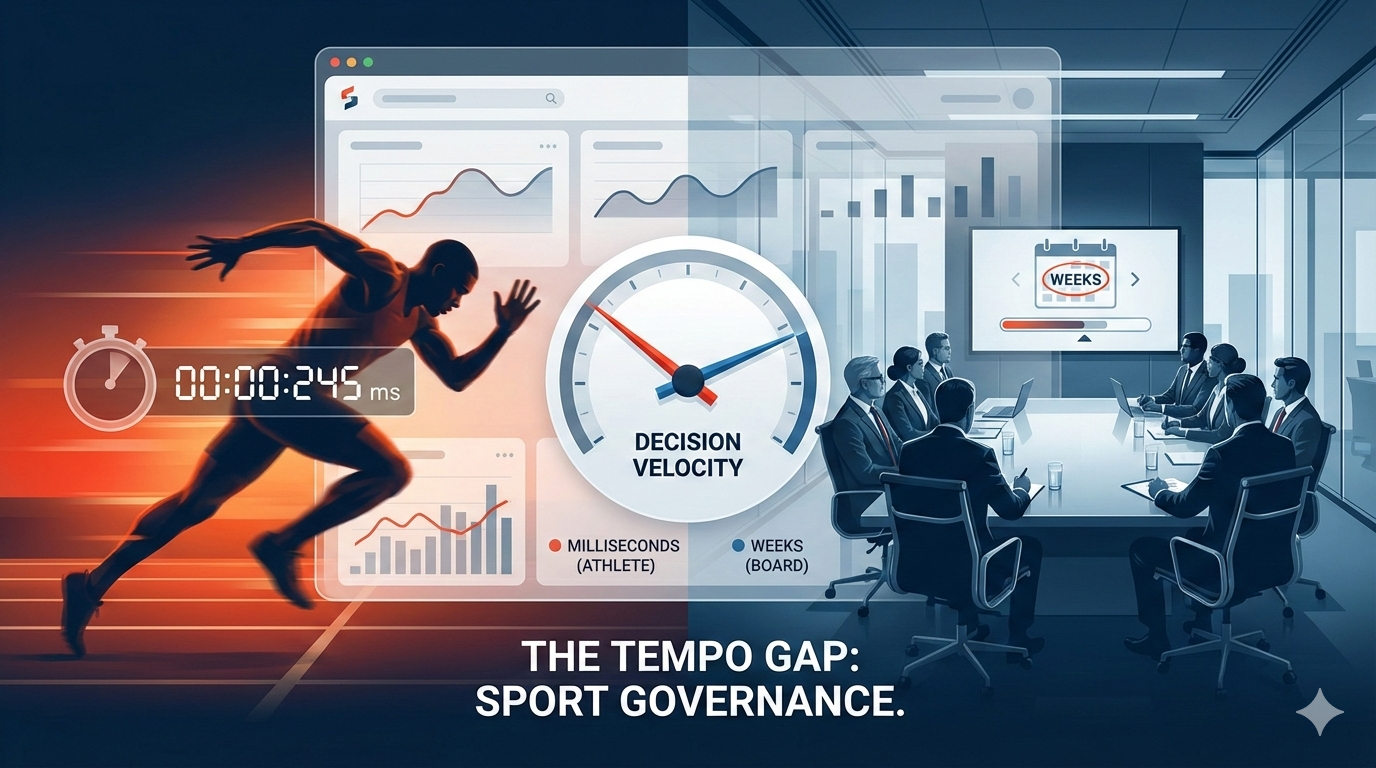
<h2>While Athletes Move in Milliseconds, Boards Operate in Meeting Cycles</h2>
<p>The 2026 Winter Olympics are happening right now.</p>
<p>Athletes make split-second decisions. Coaches adjust tactics in real-time. Performance margins are measured in hundredths of a second.</p>
<p>And back at federation headquarters?</p>
<p>Decision-making is measured in <strong>weeks</strong>.</p>
<p>Here's the uncomfortable question every sport board should ask:</p>
<p><strong>How long does it take to approve a coaching hire?</strong></p>
<p><strong>How long to resolve a selection dispute?</strong></p>
<p><strong>How long to reallocate funding mid-cycle?</strong></p>
<p>If that timeline exceeds your competitive window, your governance isn't just slow—it's <strong>strategically misaligned</strong> to the performance reality your athletes operate in.</p>
<p>The truth is, most federations don't have a governance problem. They have a <strong>tempo problem</strong>.</p>
<p>And tempo problems have real consequences.</p>
</section>
<section id="cost-of-slow-decisions">
<h2>The Cost of Slow Decisions: Evidence from Recent Governance Failures</h2>
<p>Consider the pattern playing out across international sport.</p>
<p>In Formula 1, the FIA's handling of financial regulation breaches created a credibility crisis—not because of the violations themselves, but because of <strong>decision delays</strong> (iSportConnect, 2025). The silence between investigation and verdict fueled speculation. By the time penalties were announced, the damage was done.</p>
<p><strong>Slow decisions don't protect integrity. They erode it.</strong></p>
<p>FIFA's post-2015 governance reforms tell a similar story. Independent oversight committees were established. Appointment power was removed from the Executive Committee. Then—without explanation—control returned to the FIFA Council. The chair of the Audit and Compliance Committee resigned. The Governance Committee chairman was ousted (Compass Lexecon, 2024).</p>
<p>The reforms collapsed because <strong>decision authority was never truly transferred</strong>. When structure says one thing but power operates another way, you don't have governance reform. You have <strong>governance theatre</strong>.</p>
<p>The NWSL safeguarding crisis followed the same pattern: years of allegations, delayed accountability, governing bodies appearing <strong>fragmented and unable to protect</strong> athletes.</p>
<p>These aren't isolated incidents. They're symptoms of decision-making processes designed for stability failing under the pressure of modern sport's demands.</p>
<p><strong>Here's the structural challenge many sport federations face:</strong></p>
<p>Many Olympic and amateur sport organisations operate with volunteer boards—passionate, committed individuals who care deeply. But volunteers often have <strong>limited availability</strong>. Board meetings happen monthly or quarterly. Decisions get tabled. Urgent issues wait for quorum.</p>
<p>The structure designed to ensure democratic oversight becomes the <strong>bottleneck</strong> preventing timely action. This isn't an indictment of volunteers—it's a design flaw in how decision rights are distributed.</p>
<p>When critical decisions can only be made at quarterly board meetings:</p>
<ul>
<li>Coaching changes wait while athlete development stalls</li>
<li>Selection disputes fester while media speculation damages reputations</li>
<li>Safeguarding concerns escalate while committees debate jurisdiction</li>
<li>Innovation requires board approval while competitors move ahead</li>
</ul>
<p>The paradox? Boards designed to protect the sport end up constraining performance (I Trust Sport, 2025; Sport Law Bulletin, 2016).</p>
</section>
<section id="decision-velocity-kpi">
<h2>Decision Velocity as a Performance KPI</h2>
<p>You track medal counts. Podium finishes. Funding ROI.</p>
<p>But when was the last time your board measured <strong>decision latency</strong>?</p>
<p>Research from McKinsey shows that organisations making faster decisions don't just move quicker—they <strong>perform better</strong>. Companies with high-quality, fast decision-making report stronger returns on capital and better overall performance (De Smet et al., 2019; McKinsey & Company, 2020).</p>
<p>But here's the pattern most boards miss:</p>
<p><strong>Speed and quality aren't opposing forces. They're complementary outcomes of good governance design.</strong></p>
<p>A four-year study examining strategic decision speed and firm performance found that fast strategic decision-making <strong>predicts subsequent firm growth and profit</strong>. The research demonstrated that decision speed mediates the relationship between organisational structure and performance outcomes (Baum & Wally, 2003; Park et al., 2021).</p>
<p>In other words: your org chart doesn't produce results. <strong>Decision velocity does.</strong></p>
<p>Studies on top management teams found that teams can achieve both fast AND high-quality decisions simultaneously through effective collaboration and coordination (Shepherd et al., 2023). Research shows organisations improve both speed and quality by <strong>categorising what decisions need to be made, by whom, and how quickly</strong> (De Smet et al., 2019).</p>
<p>Why does slow decision-making feel careful when it's actually indecisive?</p>
<p>Because when decision-making drags, you're not gathering better information. You're creating <strong>decision debt</strong>—accumulated uncertainty that compounds into crisis when pressure hits.</p>
</section>
<section id="three-metrics">
<h2>Three Metrics Your Board Should Track Tomorrow</h2>
<p>If you're serious about governance as performance infrastructure, start measuring:</p>
<h3>1. Average Time to Critical Decision</h3>
<p>From when a decision point is identified to when action is authorised.</p>
<p>Not "discussed." Not "tabled for next meeting."</p>
<p><strong>Decided</strong>.</p>
<p>Track this for:</p>
<ul>
<li>Coaching appointments or dismissals</li>
<li>Mid-cycle funding reallocation</li>
<li>Selection disputes</li>
<li>Safeguarding escalations</li>
<li>Crisis communication responses</li>
</ul>
<p>The goal isn't speed for speed's sake. It's <strong>alignment between decision windows and competitive reality</strong>.</p>
<p><strong>How to implement this:</strong></p>
<p>Start with a baseline audit. Pick the last five critical decisions your organisation made. Map the timeline from problem identification to authorised action. Include:</p>
<ul>
<li>Days waiting for next scheduled meeting</li>
<li>Days spent in "consultation" without decision authority</li>
<li>Days lost to unclear ownership (who actually decides?)</li>
</ul>
<p>You'll likely find patterns. In many federations, decisions requiring board approval take weeks or months, while decisions delegated to staff take days.</p>
<p>The question becomes: <strong>Which decisions genuinely require board-level deliberation, and which are waiting simply because no one has authority to act?</strong></p>
<p>As organisational design research demonstrates, <strong>clarity of decision ownership cuts through noise</strong> and drives execution forward (Organizational Physics, 2025). When teams debate endlessly without clarifying who owns the call, you don't have good governance—you have paralysis.</p>
<h3>2. Escalation Frequency</h3>
<p>How often do decisions migrate upward unnecessarily?</p>
<p>If your Head of Performance can't approve a £5,000 sports science investment without board sign-off, you don't have governance—you have a <strong>bureaucratic maze</strong>.</p>
<p>Escalation isn't bad when it's <strong>by design</strong>. It's catastrophic when it's <strong>by default</strong> because no one knows who owns the decision.</p>
<p>As we explored in a previous article on decision rights, undefined authority doesn't slow decisions—it shifts them to whoever feels safest acting, usually at the worst possible moment.</p>
<p>Measure escalation by tracking:</p>
<ul>
<li><strong>Upward escalations:</strong> Decisions pushed to higher authority than necessary</li>
<li><strong>Lateral escalations:</strong> Decisions bouncing between departments without resolution</li>
<li><strong>External escalations:</strong> Decisions requiring outside advisors when internal expertise exists</li>
</ul>
<p>High escalation frequency reveals structural problems:</p>
<ul>
<li><strong>Lack of delegation:</strong> Staff don't have authority matched to responsibility</li>
<li><strong>Risk aversion:</strong> Fear of consequences outweighs confidence to decide</li>
<li><strong>Unclear thresholds:</strong> No one knows which decisions require escalation</li>
</ul>
<p>The fix isn't telling people to "just decide." It's <strong>defining decision rights</strong> so people know what's within their authority and what genuinely needs escalation.</p>
<h3>3. Decision Reversal Rate</h3>
<p>How often does your organisation reverse or significantly amend decisions shortly after making them?</p>
<p>High reversal rates signal:</p>
<ul>
<li>Poor initial clarity</li>
<li>Insufficient input gathering</li>
<li>Rushed execution without stakeholder alignment</li>
</ul>
<p>But here's the nuance: <strong>zero reversals</strong> isn't the goal either.</p>
<p>If you never reverse a decision, you're probably not deciding fast enough to test, learn, and adapt.</p>
<p>Research on high-performing teams shows they use a "disagree and commit" principle. The decision-maker doesn't need consensus—just perspective from downstream stakeholders. Then they decide. If new information emerges, they adjust (Organizational Physics, 2025).</p>
<p>The sweet spot? <strong>Fast decisions with structured review points</strong>, not slow decisions disguised as "careful deliberation."</p>
<p>Track reversals in context:</p>
<ul>
<li><strong>Within 7 days:</strong> Likely poor initial decision process</li>
<li><strong>Within 30 days:</strong> New information emerged (acceptable)</li>
<li><strong>Within 90 days:</strong> Strategic shift based on performance data (healthy adaptation)</li>
</ul>
<p>Sport federations should aim for low short-term reversals (better initial decisions) while accepting mid-term adjustments as evidence of <strong>adaptive governance</strong>.</p>
</section>
<section id="decision-ready-governance">
<h2>What "Decision-Ready" Governance Looks Like</h2>
<p>Here's what separates high-velocity systems from decision-paralysed ones:</p>
<h3>Clear Decision Ownership</h3>
<p>Not committees. Not "shared accountability."</p>
<p><strong>One role owns each decision type.</strong></p>
<p>Then you define:</p>
<ul>
<li>What input they must consider</li>
<li>Who they must inform</li>
<li>When they escalate (not because they're unsure, but because it's outside their scope)</li>
</ul>
<p>Alignment beats ambition every time. You don't need more resources to create speed. You need <strong>honesty about who decides what</strong>.</p>
<p>Here's what this looks like in practice:</p>
<p><strong>Selection decisions:</strong> Performance Director owns athlete selection within published criteria. Board owns approval of selection criteria at the start of each cycle. If a selection falls outside criteria (injury exception, discretionary pick), it escalates to a pre-defined Selection Panel with 48-hour decision authority.</p>
<p><strong>Budget reallocation (mid-cycle):</strong> CEO can reallocate up to 10% of approved budget within performance categories. Reallocations exceeding 10% or moving funds between major categories require board approval. Emergency reallocations (injury, unexpected opportunity) can be approved by Board Chair with ratification at next board meeting.</p>
<p><strong>Crisis communication:</strong> Communications Director owns immediate response (within 4 hours). CEO owns strategic messaging direction. Board Chair owns stakeholder communication to major funders. All roles activated simultaneously, not sequentially.</p>
<p>Notice the pattern? <strong>Authority is distributed based on expertise and proximity to the decision</strong>, not seniority or title.</p>
<h3>Pre-Approved Innovation Budgets</h3>
<p>Give performance directors authority to test, pilot, and experiment within defined parameters <strong>without seeking approval each time</strong>.</p>
<p>Speed isn't recklessness when it's bounded by clear guardrails.</p>
<p>Example framework:</p>
<ul>
<li>5% of annual performance budget designated as "innovation budget"</li>
<li>Performance Director has full authority to deploy</li>
<li>Monthly reporting on experiments, learnings, outcomes</li>
<li>Board reviews aggregate results quarterly</li>
<li>Successful pilots incorporated into next year's core budget</li>
</ul>
<p>This approach enables <strong>fast iteration</strong> while maintaining oversight through structured reporting rather than pre-approval bureaucracy. As research on organisational agility shows, organisations that delegate decision-making to frontline employees and critical roles navigate change better than those requiring centralised approval (McKinsey & Company, 2020).</p>
<h3>Crisis Escalation Thresholds</h3>
<p>Not: "Let's discuss this at the next board meeting."</p>
<p>But: <strong>"If X happens, Y person decides. If unavailable, Z has backup authority."</strong></p>
<p>Safety-critical sectors like aviation and healthcare don't debate authority mid-crisis. They <strong>rehearse decision pathways</strong> so everyone knows who acts when pressure peaks.</p>
<p>Sport can learn from this.</p>
<p>Define clear thresholds:</p>
<p><strong>Safeguarding concerns:</strong></p>
<ul>
<li><strong>Immediate threat to athlete safety:</strong> Performance Director can suspend individual immediately, CEO notified within 2 hours, Board Chair within 24 hours</li>
<li><strong>Allegation requiring investigation:</strong> CEO activates pre-approved independent investigator, informs Board Chair same day</li>
<li><strong>Media inquiry on safeguarding issue:</strong> Communications Director provides holding statement within 2 hours using pre-approved language framework</li>
</ul>
<p><strong>Selection disputes:</strong></p>
<ul>
<li><strong>Athlete appeals published selection criteria:</strong> Performance Director responds within 48 hours with written rationale</li>
<li><strong>Appeal challenges criteria application:</strong> Independent Selection Panel convenes within 5 days</li>
<li><strong>Legal challenge threatened:</strong> CEO and Board Chair notified immediately, pre-approved legal counsel engaged</li>
</ul>
<p><strong>Funding crisis (government cuts, sponsor withdrawal):</strong></p>
<ul>
<li><strong><10% budget impact:</strong> CEO reallocates within existing authority</li>
<li><strong>10-25% impact:</strong> Emergency board meeting within 7 days</li>
<li><strong>>25% impact:</strong> Emergency board meeting within 48 hours, athlete stakeholder consultation initiated same day</li>
</ul>
<p>The value isn't just in <strong>having</strong> these thresholds. It's in <strong>rehearsing</strong> them before crisis hits.</p>
<h3>Decision Traceability</h3>
<p>Document:</p>
<ul>
<li>Who made the decision</li>
<li>When</li>
<li>Based on what information</li>
<li>With what authority</li>
</ul>
<p>Not for blame. For <strong>learning</strong>.</p>
<p>Decision traceability serves three critical functions:</p>
<p><strong>1. Accountability without paralysis:</strong> When decision-makers know their choices will be visible (not anonymised), they make better decisions. But when traceability becomes blame culture, it creates the opposite: decision avoidance.</p>
<p>The balance? <strong>Trace the decision pathway, not just the outcome.</strong> If a decision was made with appropriate authority, using available information, following established process—it's a good decision even if outcomes disappoint.</p>
<p><strong>2. Organisational learning:</strong> Pattern analysis of decisions reveals systemic issues. If 80% of selection disputes stem from unclear published criteria, the problem isn't individual decisions. It's the selection framework itself.</p>
<p><strong>3. AI governance foundation:</strong> As AI increasingly informs performance decisions—selection algorithms, injury prediction models, load management systems—decision traceability shifts from "nice to have" to <strong>governance essential</strong>.</p>
<h3>The AI Governance Challenge</h3>
<p>Here's where decision velocity meets algorithmic accountability:</p>
<p><strong>Algorithms operate at machine speed. Governance operates at meeting speed.</strong></p>
<p>An injury prediction model flags an athlete as high-risk. Should they compete?</p>
<p>The algorithm says no. The athlete says they feel fine. The coach trusts their judgment. The medical team sees marginal data. The selection is tomorrow.</p>
<p><strong>Who decides?</strong></p>
<p>If this scenario requires convening a committee, you've already lost competitive advantage. But if one person decides without documented authority, you've created liability exposure.</p>
<p>The solution isn't banning AI from decision-making. It's <strong>pre-defining decision rights for algorithm-informed choices</strong>:</p>
<p><strong>Before deployment:</strong></p>
<ul>
<li>Board approves use cases where AI will inform decisions (selection, injury prediction, load management)</li>
<li>Board defines <strong>authority levels</strong>: AI-recommended, AI-informed, AI-overridable</li>
<li>Board establishes who has override authority and under what conditions</li>
</ul>
<p><strong>During operations:</strong></p>
<ul>
<li>Performance Director owns day-to-day interpretation of AI outputs</li>
<li>Medical Director has absolute override authority on health-safety decisions</li>
<li>CEO has override authority when reputational risk exceeds performance benefit</li>
</ul>
<p><strong>After decisions:</strong></p>
<ul>
<li>All AI-informed decisions logged with: model output, human interpretation, override rationale (if applicable)</li>
<li>Quarterly review of override patterns to identify model bias or systemic issues</li>
<li>Annual board review of AI governance effectiveness</li>
</ul>
<p>This isn't theoretical. Federations that design decision velocity into their AI governance <strong>before</strong> controversy hits will maintain competitive advantage. Those that wait will face the worst combination: <strong>slow human decision-making trying to govern fast algorithmic recommendations</strong>.</p>
</section>
<section id="building-velocity">
<h2>Building Decision Velocity: Three Essential Conversations</h2>
<p>Redesigning decision velocity doesn't require restructuring your entire organisation. It requires <strong>three honest conversations</strong>:</p>
<h3>1. Map Your Current Decision Reality</h3>
<p>Pick three recent high-pressure decisions.</p>
<p>Trace the pathway. Who was consulted? Who advised? <strong>Who actually made the call?</strong></p>
<p>Compare that to what your governance documents say should have happened. The gap is your starting point.</p>
<p>Look for patterns:</p>
<ul>
<li>Decisions that should take days but take weeks</li>
<li>Authority that's documented but not exercised</li>
<li>Escalations that happen out of fear, not necessity</li>
</ul>
<p>This isn't an audit to assign blame. It's a <strong>diagnostic</strong> to identify where structure and reality diverge.</p>
<h3>2. Define Decision Ownership (Not Just Accountability)</h3>
<p>Accountability is retrospective. Ownership is real-time.</p>
<p>For every critical decision type, <strong>name one role</strong> that owns it. Not after the fact. <strong>In the moment.</strong></p>
<p>Use this framework:</p>
<ul>
<li><strong>Strategic decisions</strong> (multi-year impact, significant budget): Board</li>
<li><strong>Operational decisions</strong> (within approved strategy, annual cycle): CEO/Performance Director</li>
<li><strong>Tactical decisions</strong> (day-to-day, within approved budgets): Functional leads</li>
</ul>
<p>Then define the connective tissue:</p>
<ul>
<li>What input must be considered before deciding?</li>
<li>Who must be informed after the decision?</li>
<li>What triggers an escalation to the next level?</li>
</ul>
<p>When everyone knows not just "who is accountable" but "who decides," tempo accelerates dramatically.</p>
<h3>3. Test Under Pressure</h3>
<p>Run a tabletop scenario:</p>
<ul>
<li>Last-minute selection change</li>
<li>Safeguarding allegation</li>
<li>Funding cut with 48 hours to respond</li>
</ul>
<p>Walk through who decides what, when.</p>
<p>If people hesitate, if authority is unclear, if the pathway defaults to "we'd need to discuss it"—you've found your weak point. Fix it <strong>before</strong> the next competitive cycle.</p>
<p>Here's what effective testing looks like:</p>
<p><strong>Scenario:</strong> Your top athlete is flagged by the injury prediction algorithm 72 hours before Olympic qualification. Medical team says marginal risk. Athlete insists they're ready. Coach says they need them.</p>
<p><strong>Questions to answer:</strong></p>
<ul>
<li>Who owns the final compete/don't compete decision?</li>
<li>What information must they have before deciding?</li>
<li>If they're unavailable, who has backup authority?</li>
<li>How quickly can this decision be made?</li>
<li>How is it documented?</li>
</ul>
<p>If your team can't answer these questions quickly and confidently, you've identified a governance gap that pressure will expose.</p>
</section>
<section id="governance-performance-gap">
<h2>The Governance Performance Gap</h2>
<p>Most sport governance codes emphasise transparency, accountability, and separation of powers. Critical foundations.</p>
<p>But they pay almost no attention to <strong>decision tempo</strong>.</p>
<p>Why does this matter?</p>
<p>Because you're operating in <strong>short cycles with long consequences</strong>. Selection windows close. Injury decisions demand immediate action. Funding announcements come with 72-hour response times. Media cycles move faster than your next board meeting.</p>
<p>As outlined in previous work on governance principles, governance that enables speed isn't about removing oversight. It's about <strong>designing decision rights</strong> so oversight happens at the right level, at the right time.</p>
<p>The evidence is clear: only 48% of organisations make decisions quickly, and just 37% achieve both high quality and speed. But organisations that do <strong>outperform peers</strong> in responsiveness, innovation, and financial results (De Smet et al., 2019).</p>
<p>Sport is no different.</p>
</section>
<section id="next-governance-shift">
<h2>The Next Governance Shift</h2>
<p>This isn't theory. It's the competitive advantage your organisation either builds now or learns about the hard way later.</p>
<p>The federations celebrating medals this Winter may not win the next cycle. The ones <strong>redesigning decision velocity right now</strong> will.</p>
<p>Why?</p>
<p>Because competitive intensity is increasing. Media scrutiny is intensifying. Athlete expectations for organisational responsiveness are rising. AI is accelerating the pace at which performance decisions can be informed.</p>
<p>And governance structures designed for stability are <strong>fundamentally misaligned</strong> to this reality.</p>
<p>You can't win on the world stage if your governance operates at a different tempo than your competitive environment.</p>
<p><strong>Great systems elevate people. Poor systems constrain them.</strong></p>
<p>And the podium has a way of revealing exactly what your decision-making systems are made of.</p>
</section>
<section id="references">
<h2>References</h2>
<p>Baum, J. R., & Wally, S. (2003). Strategic decision speed and firm performance. <em>Strategic Management Journal</em>, 24(11), 1107-1129.</p>
<p>Compass Lexecon. (2024). Governance and competition – The case of sports. Retrieved from <a href="https://www.compasslexecon.com/insights/publications/governance-and-competition-the-case-of-sports">https://www.compasslexecon.com/insights/publications/governance-and-competition-the-case-of-sports</a></p>
<p>De Smet, A., Jost, G., & Weiss, L. (2019). Three keys to faster, better decisions. <em>McKinsey Quarterly</em>. Retrieved from <a href="https://www.mckinsey.com/capabilities/people-and-organizational-performance/our-insights/decision-making-in-the-age-of-urgency">https://www.mckinsey.com/capabilities/people-and-organizational-performance/our-insights/decision-making-in-the-age-of-urgency</a></p>
<p>iSportConnect. (2025). Beyond the headlines: The governance cracks that shaped sport in 2025. Retrieved from <a href="https://www.isportconnect.com/beyond-the-headlines-the-governance-cracks-that-shaped-sport-in-2025">https://www.isportconnect.com/beyond-the-headlines-the-governance-cracks-that-shaped-sport-in-2025</a></p>
<p>I Trust Sport. (2025). Good sports governance. Retrieved from <a href="https://www.itrustsport.com/sports-governance/tackling-sports-corruption/good-sports-governance">https://www.itrustsport.com/sports-governance/tackling-sports-corruption/good-sports-governance</a></p>
<p>McKinsey & Company. (2020). Reimagine decision making to improve speed and quality. Retrieved from <a href="https://www.mckinsey.com/capabilities/people-and-organizational-performance/our-insights/the-organization-blog/reimagine-decision-making-to-improve-speed-and-quality">https://www.mckinsey.com/capabilities/people-and-organizational-performance/our-insights/the-organization-blog/reimagine-decision-making-to-improve-speed-and-quality</a></p>
<p>Organizational Physics. (2025). The #1 way to speed up decision-making. Retrieved from <a href="https://organizationalphysics.com/2025/07/07/the-1-way-to-speed-up-decision-making">https://organizationalphysics.com/2025/07/07/the-1-way-to-speed-up-decision-making</a></p>
<p>Park, C., Kim, W., & Song, J. H. (2021). The influence of strategic decision making on organizational performance. <em>The International Journal of Business & Management</em>, 9(2), 95-112.</p>
<p>Seifried, C., Kang, S., & Jisha, J. M. (2023). Exploring the dynamics of governance: An examination of traditional governance and governance innovation in the United States professional sports leagues. <em>Frontiers in Sports and Active Living</em>, 5. Retrieved from <a href="https://pmc.ncbi.nlm.nih.gov/articles/PMC11259793">https://pmc.ncbi.nlm.nih.gov/articles/PMC11259793</a></p>
<p>Shepherd, D. A., Bastian, B., & Helfat, C. E. (2023). Fast and high‐quality decision‐making: The role of behavioral integration. <em>European Management Review</em>, 20(3), 573-591.</p>
<p>Sport Law Bulletin. (2016). The future of sports governance: Will sport sustain its traditional model of autonomy? Retrieved from <a href="https://www.sportslawbulletin.org/future-sports-governance-will-sport-sustain-its-traditional-model-autonomy">https://www.sportslawbulletin.org/future-sports-governance-will-sport-sustain-its-traditional-model-autonomy</a></p>
</section>
</article>