Leadership
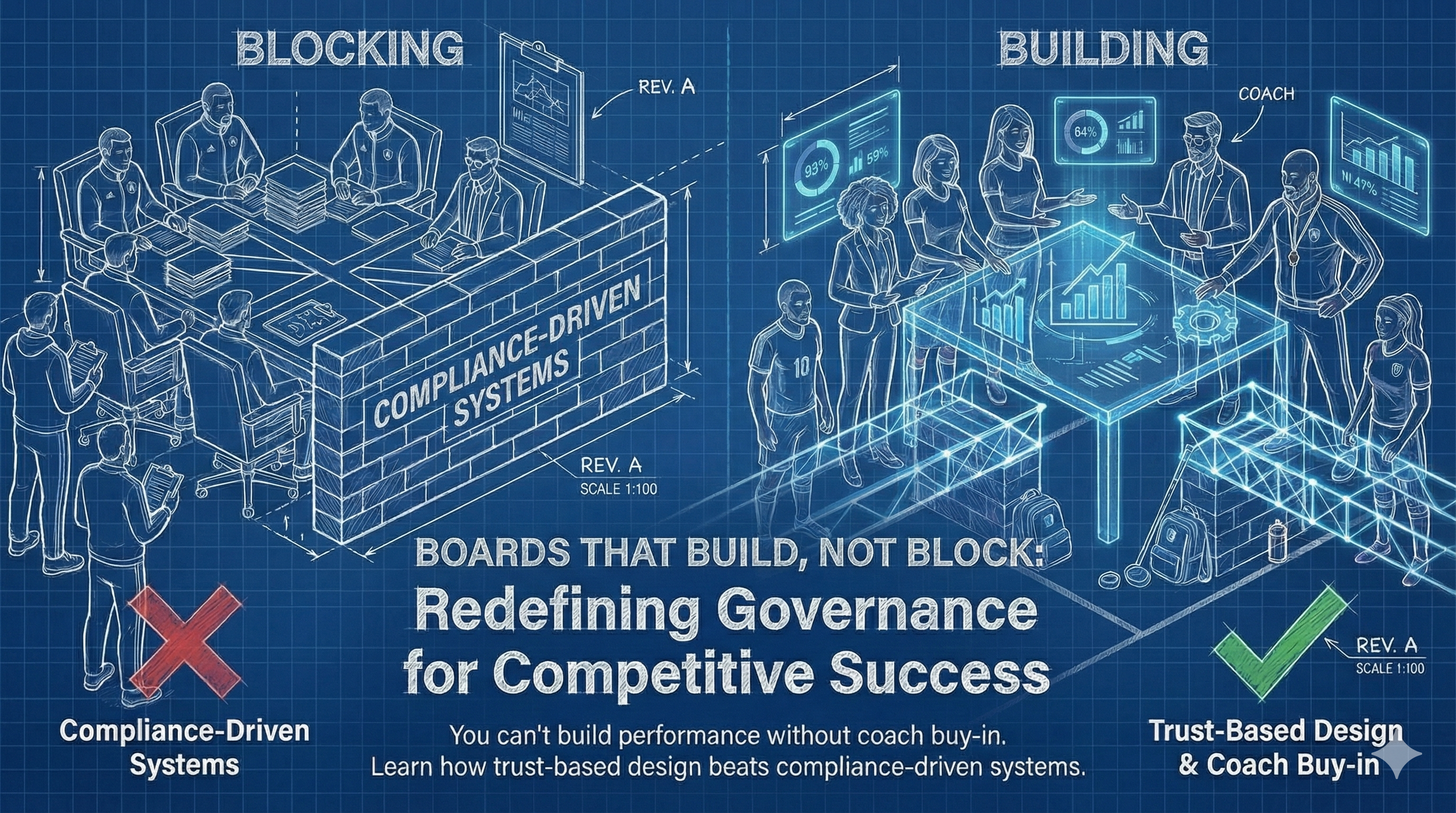
Boards That Build, Not Block: Redefining Governance for Competitive Success
You can't build performance without coach buy-in. Learn how trust-based design beats compliance-driven systems.
Let's be honest.
You can have the slickest strategy deck in the world. You can have a constitution written by the finest legal minds. You can have board meetings that run with Swiss-watch precision.
But if the National Team Coach on the ground rolls their eyes every time "The Board" is mentioned?
You've already lost.
Here's the uncomfortable truth sitting in boardrooms across sport right now: you cannot build high performance without coach buy-in. It's impossible. Why? Because systems don't win medals. People do. And if the people closest to the field of play don't trust the system, they won't use it.
They'll work around it.
I’ve spent my career operating at the intersection of sports, business, and technology. I’ve advised International Federations, seen the engine room of global enterprises, and worked with scrappy National Governing Bodies (NGBs).
And here is the absolute truth: Great systems elevate people. Poor systems constrain them.
Far too many sporting organisations today are running on governance systems designed to constrain. They're built on fear. They're built for compliance, not for competition.
If your board is seen as the "Department of No," or the place where good ideas go to die in committee meetings, you aren't just frustrating your staff. You're actively capping your organisation's competitive potential.
It's time to redefine governance. We need boards that build, not block.
The Compliance Trap: Why "Safe" is Actually Risky
Don't get me wrong. Compliance is vital. It's like plumbing. You absolutely need it to work perfectly, or things get very messy, very fast. You need strong financial controls, robust safeguarding policies, and clear legal frameworks.
But plumbing is not strategy. Plumbing doesn't win championships.
The problem arises when the entirety of governance becomes about risk mitigation and box-ticking. This is what I call the "Compliance Trap."
In this model, the board sees its primary role as a watchdog. The dynamic is parent-child. The board demands reports, scrutinises operational details, and slows things down to ensure "safety."
The result? Sludge.
Decision-making slows to a crawl. Opportunities are missed. Innovation dies because it's too exhausting to get approval to try something new.
Let me paint you a picture. You've got a talented coach—someone who lives and breathes athlete development. They've got ideas, energy, and a track record that speaks for itself.
Then they hit your governance system.
Suddenly, every decision needs three approvals. Every innovation gets filtered through committees that haven't stepped on a training ground in years. Every risk—no matter how calculated—gets shut down because "that's not how we do things here."
What happens next?
That coach checks out. Not officially. They still show up. But the fire? Gone. The innovation? Dead. The athlete-first mentality that made them exceptional? Buried under layers of bureaucratic self-preservation.
Research from the Centre for Creative Leadership found that organisations with coaching cultures report 61% higher employee engagement and are more likely to outperform their competitors. But here's the kicker: you can't mandate a coaching culture. You can't policy your way into buy-in.
You have to earn it through trust.
For large International Federations, this is devastating. For smaller, growing organisations? It's practically fatal.
Think about NGBs that are largely athlete-funded. Every dollar spent on administrative sludge or redundant compliance theatre is a dollar not spent on coaching, facilities, or athlete support. When athletes are funding their own journey, inefficient governance isn't just annoying—it's a breach of trust.
Research in organisational behaviour consistently shows that excessive controls implemented without trust actually decrease overall performance. When people feel untrusted, they stop taking ownership. They just follow the rules.
And "just following the rules" never led to a gold medal.
Trust-Based Design: The Speed of Competition
So, what's the alternative?
It's moving toward what I call <b>Trust-Based Design</b> within a High-Performance System.
A "building" board understands that its primary role isn't just to stop bad things from happening, but to accelerate good things happening.
This demands a massive cultural shift. It means moving from a mindset of "command and control" to "align and empower."
When I work with executives and boards, I often use the analogy of elite motor racing.
The Board is not the driver. The CEO or High-Performance Director is the driver.
The Board isn't even the pit crew changing the tyres in three seconds flat. That's operations.
The Board is the Race Strategy Team sitting on the pit wall, looking at the telemetry data, monitoring the weather, checking the competition's lap times, and ensuring the team has the resources to finish the race.
They set the parameters. They agree on the race strategy with the driver. And then? They trust the driver to drive.
They don't grab the steering wheel in the middle of a corner.
When a board operates with Trust-Based Design, several things happen instantly:
<ol>
<li> Speed increases. Decisions happen closer to the action.</li>
<li> Accountability deepens. When you empower leaders, they own the outcome.</li>
<li> Alignment tightens. Everyone understands the "why," not just the "what."</li>
</ol>
The best part? Trust is cheaper than control.
Building elaborate monitoring systems to catch people doing the wrong thing is expensive and exhausting. Investing in aligning good people around a shared vision and trusting them to execute is highly scalable.
OECD research demonstrates that trust is a fundamental driver of institutional performance, with transparent and responsive governance structures directly correlating to higher stakeholder confidence and better outcomes. Grant Thornton's work on governance reform shows that organisations building cultures of trust and transparency consistently outperform those focused purely on compliance.
The Ultimate Litmus Test: Athlete First
How do you know if your governance is working?
You apply the only test that matters in our world: Is it Athlete First?
I love this phrase, but it gets abused. It's often plastered on a wall but ignored in the boardroom.
True Athlete-Centric governance means that every major board decision—from budgeting to bylaws—is filtered through the lens of its impact on the athlete's environment.
If a governance process is so clumsy that it forces a coach to spend ten hours on paperwork instead of ten hours analysing game film, that governance system is anti-athlete.
If financial models are structured to feed the bureaucracy rather than the performance pathway, that system is failing its primary stakeholders.
The truth is, athletes and coaches know who supports them and who the bureaucracy is serving.
They can smell inauthenticity a mile away. If the board talks about "gold medal standards" but operates with "bronze medal speed," the disconnect destroys culture.
Studies from INSEAD show that boards with high psychological safety are more innovative, make better strategic decisions, and respond faster to competitive threats. That's not soft leadership—that's competitive advantage.
A Blueprint for Boards That Build
Redefining governance isn't about throwing out the rulebook. It's about evolving it for the speed of modern sports and business.
If you want a board that builds competitive advantage rather than blocking it, you need to focus on three critical areas:
<b>1. Radical Clarity on Roles (The "Swim Lanes")</b>
The biggest source of friction is the blurring of lines between "Governance" (the board's job) and "Management" (the staff's job).
Boards govern. They hire and fire the CEO, set strategic direction, ensure financial stability, and manage high-level risk.
Management executes. They run the day-to-day, hire staff, deliver the programmes, and own operational decisions.
When boards start meddling in management, they become blockers. A building board demands clarity. They define the "swim lanes" ruthlessly and then stay in their own lane.
<b>2. Dynamic Alignment and Scalability</b>
Traditional governance is static. You set a 5-year plan and review it quarterly.
In today's world? That's too slow.
Look at the rise of AI Governance. Is your board agile enough to create frameworks for using AI in talent identification or fan engagement right now? Or will it take two years to form a sub-committee to write a policy that's obsolete by the time it's published?
A building board creates alignment frameworks that are dynamic. They allow the organisation to pivot quickly without losing sight of the ultimate goal. They build systems designed to scale, not just survive.
Research on agile governance shows that organisations making decisions at the right level—not pushing everything up—are faster, more innovative, and better positioned for competitive success.
<b>3. The Courage to Measure Culture</b>
This is the hardest one.
Most boards are comfortable measuring finances. They're comfortable measuring medal counts or sales figures.
Few are brave enough to measure trust.
A board that's serious about building needs to regularly take the temperature of the organisation.
Do the staff trust the board? Does the High-Performance Director feel empowered or micromanaged?
You have to be willing to hear the answers. Blunt honesty is required. Without that feedback loop, you're flying blind.
The Mirror Moment
Governance isn't sexy. It doesn't get the headlines. But it is the bedrock upon which sustained competitive success is built.
If your governance structures were designed twenty years ago, they were designed for a world that no longer exists.
If your board meetings feel like a hostage negotiation rather than a strategy session, something is broken.
We have to do better. For the coaches, for the staff, and most importantly, for the athletes who rely on us to provide an environment where they can thrive.
It's time to look in the mirror.
Is your board a blocker? Does it force your best people to navigate obstacle courses of red tape?
Or is your board a builder? Does it provide the foundation, the resources, and the trust necessary for high performance to flourish?
Your competitors are figuring this out. The organisations winning right now—whether that's in medal tables or market share—aren't the ones with the thickest policy manuals. They're the ones with aligned, trust-based systems that move faster, innovate smarter, and keep their best people engaged.
The question isn't whether trust-based governance works.
The question is: how much longer can you afford to ignore it?
Where Do You Start?
Look, I get it. Changing governance isn't easy. Especially when you've got board members who've been doing it the same way for twenty years. When you've got legal advisors who default to "no" because it's safer. When you've got limited resources and a thousand competing priorities.
But here's the thing: you don't have to overhaul everything overnight.
You just need to know where you are—and what your next intelligent move is.
Knowing where you stand is the first step toward redefining your competitive future.
Are you ready to find out the truth about your organisation's governance engine?
I've developed a specialised tool designed to cut through the noise and give you a clear picture of where you stand.
Take the <a href="https://glenviewsports.co/scorecard">HP Systems Readiness Scorecard</a> now. It takes less than 5 minutes, and you'll receive a personalised recommendation based on your organisation's current position to help you start building, not blocking.
Because your athletes deserve better than governance that gets in the way.
They deserve governance that gets them to the podium.
<b>Let's build it!</b>
References
Centre for Creative Leadership. (2025). How to Instill a Coaching Culture.
Grant Thornton Ireland. (2023). Good governance: Building a culture of trust and transparency.
INSEAD. (2025). When Psychological Safety Has a Seat on the Board.
Kearney. Agile Governance: Making the Right Decisions at the Right Time.
OECD. (2014). Trust: What it is and Why it Matters for Governance and Education.