High Performance
Athletes on Boards Don't Make Governance Athlete-Centred
Research into athlete-centred governance shows that influence can be temporary. It says less about how influence fades while the seat is still filled.
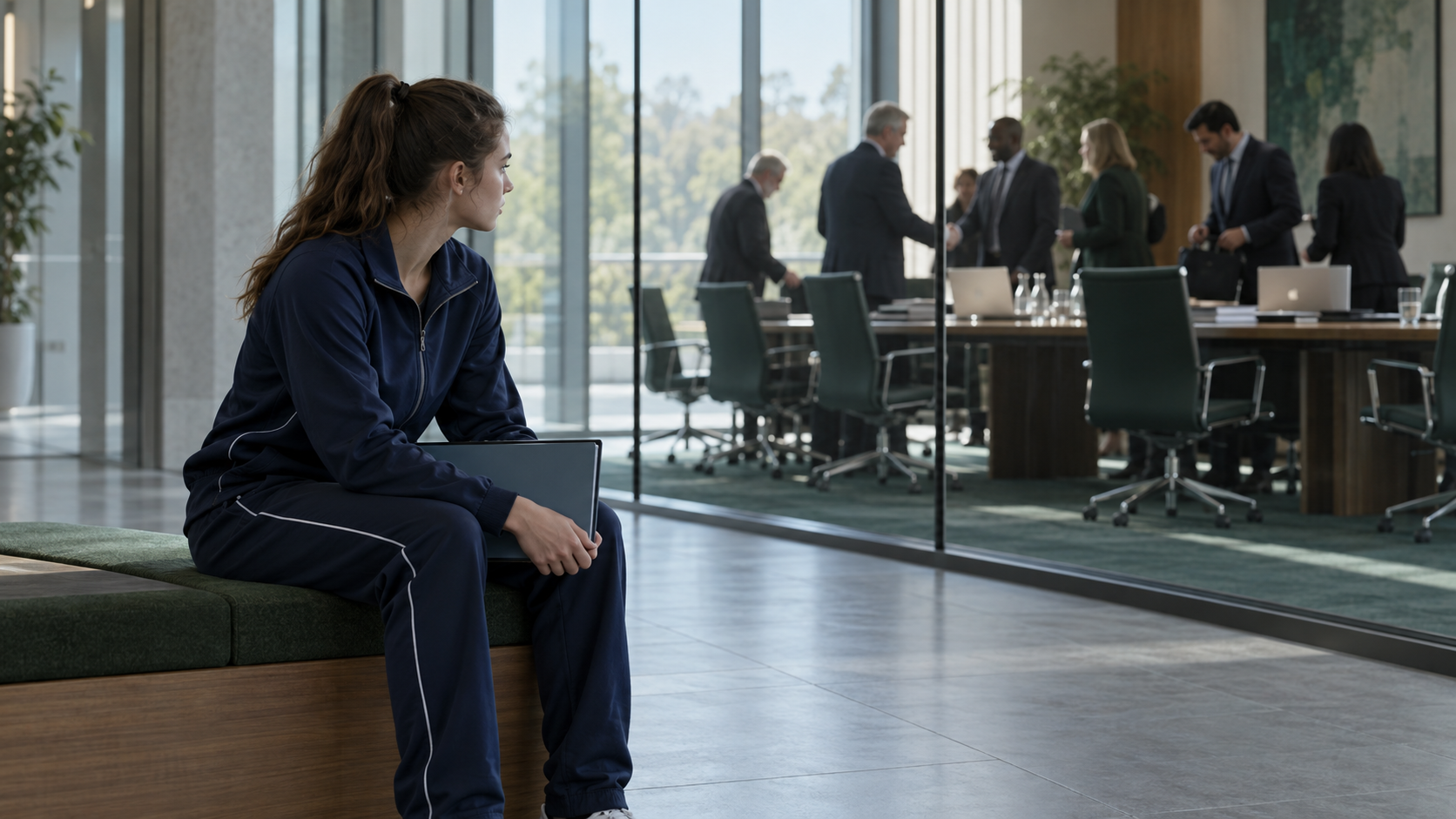
<p>Ahead of the 2015 Toronto Pan American and Parapan American Games, nine athletes sat on an advisory council for the organising committee. Their recommendations shaped the village, from bed procurement to catering. During the Games they served as the village’s “mayors”, walking it every day and dealing with problems as they came up. Then the Games ended. The council was dissolved, and no formal mechanism carried forward what it had learned.<sup><a href="#note-1">1</a></sup></p>
<p>This is one of the better-documented examples of athlete-centred governance in recent sport. Any board about to fill an athlete seat should read it closely.</p>
<h2 id="why-this-matters-now">Why this matters now</h2>
<p>Athlete representation is moving from good intention to formal requirement.</p>
<p>India’s National Sports Governance Act 2025 requires every national sports body to include at least two sportspersons of outstanding merit, and two members elected from its Athletes Committee, on an executive committee of no more than fifteen.<sup><a href="#note-2">2</a></sup> In August 2025, NCAA Division I added 40 voting seats for student-athletes, doubling their voting representation across its committees.<sup><a href="#note-3">3</a></sup> In Europe, the EOC EU Office’s governance roadmap recommends that an athletes’ commission hold at least one elected, voting seat on the board and at least two in the General Assembly, and that the commission’s Chair be a full member of the board.<sup><a href="#note-4">4</a></sup> The roadmap is guidance rather than law, but it gives reviewers a benchmark to hold federations to.</p>
<p>Each of these measures counts seats. None of them measures whether athlete input changes a decision.</p>
<h2 id="the-principle">The principle</h2>
<p>A seat is an input. Influence is an output.</p>
<p>A board can meet every representation requirement and still make the same decisions it would have made with no athletes in the room. A review that counts seats will not see the difference. Whether representation becomes influence depends on how the governance system is designed.</p>
<h2 id="what-the-evidence-shows">What the evidence shows</h2>
<p>The Toronto research is the most detailed recent evidence, and its findings are largely positive.</p>
<p>A survey of 829 athletes from 42 sports rated their Games experience highly, with an average satisfaction score of 4.59 on a five-point scale, where 5 is excellent.<sup><a href="#note-5">5</a></sup> The survey covered Toronto alone, with no earlier Games to compare against, so it shows athletes were satisfied, not that the council caused it. The council’s influence is documented separately. Its members were placed in functional areas across the organising committee, and its recommendations shaped operational decisions.<sup><a href="#note-1">1</a></sup></p>
<p>The companion case study calls this “bounded empowerment”. Athletes exercised influence “relationally, operationally, and epistemically rather than primarily through formal voting power.”<sup><a href="#note-1">1</a></sup> They shaped how the Games were delivered. Final authority stayed with the organising committee, and when athlete priorities conflicted with other pressures, the other pressures sometimes won.</p>
<p>The study concludes that “the influence of athletes is transient and not based on an actual shift in power, but on temporary needs of the organization.”<sup><a href="#note-1">1</a></sup></p>
<p>A second study examined athlete representation in transnational sport governance. It found that Olympic Movement athlete commissions did make collective decisions within their formal remit. Some of the pressure that shifted wider decisions came from outside that structure, as independent athlete groups criticised Olympic Movement practices in public and turned to national legal systems.<sup><a href="#note-6">6</a></sup></p>
<p>Neither study shows influence secured by the seat alone. In both, influence depended on the organisation needing it or on pressure from outside.</p>
<h2 id="how-consultation-turns-into-ratification">How consultation turns into ratification</h2>
<p>The research shows that influence can be temporary. It says less about how influence fades while the seat is still filled.</p>
<p>One first-hand account comes from World Lacrosse. The author of this article was founding Chair, then Co-Chair, of its Athletes’ Commission, and sat on its board. The early years had real energy. Athletes were consulted early, and their input reached decisions while those decisions were still being formed. Over time that changed. The novelty wore off, and the weight given to athlete input came to depend on whether a topic was seen as strategic or operational. More often, decisions were settled elsewhere and brought to athlete representatives for ratification. No seat was removed, but the seats were used differently.</p>
<p>That is one account, and it proves nothing about federations in general. It is consistent with the Toronto finding, though. Influence that rests on an organisation’s need for it lasts only as long as the need does.</p>
<h2 id="the-constraints">The constraints</h2>
<p>Some of the reasons for this drift are legitimate.</p>
<ol type="1">
<li><strong>Boards have to move.</strong> Not every decision can wait for a full consultation cycle. Speed is a real governance requirement.</li>
<li><strong>Athlete representatives are part-time and they rotate.</strong> Many are volunteers, some are still competing, and they change every few years. What they know leaves with them, as Toronto showed.</li>
<li><strong>Not every decision needs athlete input.</strong> Sending everything to the athletes’ commission would slow the board down and wear the commission out.</li>
<li><strong>Seats and power can move in opposite directions.</strong> The same NCAA reform that doubled student-athlete votes also increased the voting weight of the largest conferences.<sup><a href="#note-7">7</a></sup> More seats at one level do not stop authority moving to another.</li>
<li><strong>The evidence is thin.</strong> The Toronto studies cover a single event, not a standing federation. The lead author was Vice-Chair of the council she studied, and both papers name this as a limitation.<sup><a href="#note-1">1</a></sup><sup><a href="#note-5">5</a></sup> An organising committee is also a temporary body, which makes comparison with a national governing body difficult.</li>
</ol>
<p>Any workable answer has to be light enough that the board can still move, and specific enough to show whether the seats are doing anything.</p>
<h2 id="the-direction">The direction</h2>
<p>More seats will not close this gap. A board needs a way to show whether the seats it already has are working.</p>
<p>Auditors already make this distinction. They test a control’s design separately from its operating effectiveness, because a well-designed control can still fail to operate. The EU’s Digital Operational Resilience Act makes the same point in law. The management body must “define, approve, oversee and be responsible for the implementation of” its ICT risk management arrangements.<sup><a href="#note-8">8</a></sup> Approval alone does not discharge that duty. The body answers for whether the arrangements work.</p>
<p>Applied to athlete representation, that gives three steps.</p>
<ol type="1">
<li><strong>Define the scope.</strong> Name the decision types where athlete input is expected: selection policy, the competition calendar, programme design, welfare, and funding that reaches athletes directly. Everything else runs as normal.</li>
<li><strong>Record the timing.</strong> For each decision in scope, record whether athlete representatives were consulted while the proposal was still open, or asked to approve it once it was settled. An athlete representative on the board confirms each entry. This adds one line to the minutes.</li>
<li><strong>Review the pattern.</strong> Once a year, the board reviews the record. If most in-scope decisions were consulted on early, representation is working. If most came to athletes for ratification, the seat has become a formality.</li>
</ol>
<p>The record will not guarantee influence, but it will show the drift while there is still time to correct it.</p>
<h2 id="who-owns-it">Who owns it</h2>
<p>The Chair, or the board member nominated as responsible for governance.</p>
<p>It should not sit with the athletes’ commission, because a commission cannot hold the board to account for the board’s own conduct. Nor should it sit with the CEO, whose executive team often writes the proposals in the first place. Whoever answers for the board’s conduct should own this record.</p>
<p>The owner is still part of the board being recorded. That is why an athlete representative confirms each entry.</p>
<h2 id="what-remains-open">What remains open</h2>
<p>This direction is provisional.</p>
<p>It rests on one well-documented case, one study of transnational governance, and first-hand experience. It should change if research on standing federations shows athlete influence holding steady across board terms without any reinforcing mechanism. It should also change if the record itself becomes a formality. That risk is real. Athlete confirmation of each entry and the annual review are the checks against it.</p>
<p>Whether substantive athlete influence produces better performance systems is still unknown. It is a reasonable hypothesis, because athletes see failure points that staff and boards miss, but it has not been shown. The argument here is narrower. If a board has decided that athletes should influence its decisions, it should be able to show that they do.</p>
<aside class="rule">
<p><strong>The Rule</strong></p>
<p>For each board decision on selection, the competition calendar, programme design, welfare or athlete funding, the Chair, or the board member nominated as responsible for governance, records whether athlete representatives were consulted before the proposal was settled or asked to ratify it afterwards. An athlete representative on the board confirms each entry. The board reviews the record once a year. If ratification is the more common pattern, the Chair reports to the board on why, and on what will change before the next review.</p>
</aside>
<p class="signature">Great systems elevate people. Poor systems constrain them.</p>
<h2 id="notes">Notes</h2>
<ol type="1">
<li id="note-1">Forrester, N. W. (2026). From rhetoric to representation: athlete-centred governance understood, constructed, and enacted in a mega-sport event. <em>Frontiers in Sports and Active Living</em>, 8, 1864884. <a href="https://doi.org/10.3389/fspor.2026.1864884">https://doi.org/10.3389/fspor.2026.1864884</a></li>
<li id="note-2">The National Sports Governance Act, 2025 (Act No. 25 of 2025), section 4(1)(b). Bill text via PRS Legislative Research: <a href="https://prsindia.org/billtrack/the-national-sports-governance-bill-2025">https://prsindia.org/billtrack/the-national-sports-governance-bill-2025</a></li>
<li id="note-3">NCAA. (5 August 2025). DI board eliminates several DI committees, increases student-athlete representation. <a href="https://www.ncaa.org/news/2025/8/5/media-center-di-board-eliminates-several-di-committees-increases-student-athlete-representation.aspx">https://www.ncaa.org/news/2025/8/5/media-center-di-board-eliminates-several-di-committees-increases-student-athlete-representation.aspx</a></li>
<li id="note-4">EOC EU Office, SIGGS 3.0 Project. (December 2024). Headline 4.4: Representativeness and participation of athletes. <a href="https://www.euoffice.eurolympic.org/wp-content/uploads/2024/11/Roadmap_P4_T4_Representativeness_and_participation_of_athletes.pdf">https://www.euoffice.eurolympic.org/wp-content/uploads/2024/11/Roadmap_P4_T4_Representativeness_and_participation_of_athletes.pdf</a></li>
<li id="note-5">Forrester, N. W., & MacIntosh, E. (2026). From rhetoric to reality: an empirical audit of athlete-centred governance in the Toronto 2015 Pan/Parapan American Games. <em>Frontiers in Sports and Active Living</em>, 8, 1864922. <a href="https://doi.org/10.3389/fspor.2026.1864922">https://doi.org/10.3389/fspor.2026.1864922</a></li>
<li id="note-6">Kihl, L. A., Adair, D., Greenhow, A., & Gowthorp, L. (2025). Deliberative spaces of elite athlete representation in transnational sport governance. <em>Journal of Sport and Social Issues</em>, 49(6), 520-545. <a href="https://doi.org/10.1177/01937235251369726">https://doi.org/10.1177/01937235251369726</a></li>
<li id="note-7">ESPN. (August 2025). NCAA revamps governance policy to expand influence of big conferences. <a href="https://www.espn.com/college-sports/story/_/id/45910050/ncaa-revamps-governance-policy-expand-influence-big-conferences">https://www.espn.com/college-sports/story/_/id/45910050/ncaa-revamps-governance-policy-expand-influence-big-conferences</a></li>
<li id="note-8">Regulation (EU) 2022/2554 on digital operational resilience for the financial sector (DORA), Article 5(2). <a href="https://eur-lex.europa.eu/eli/reg/2022/2554/oj/eng">https://eur-lex.europa.eu/eli/reg/2022/2554/oj/eng</a></li>
</ol>