Leadership
A Seat at the Table Is Not a Decision Right
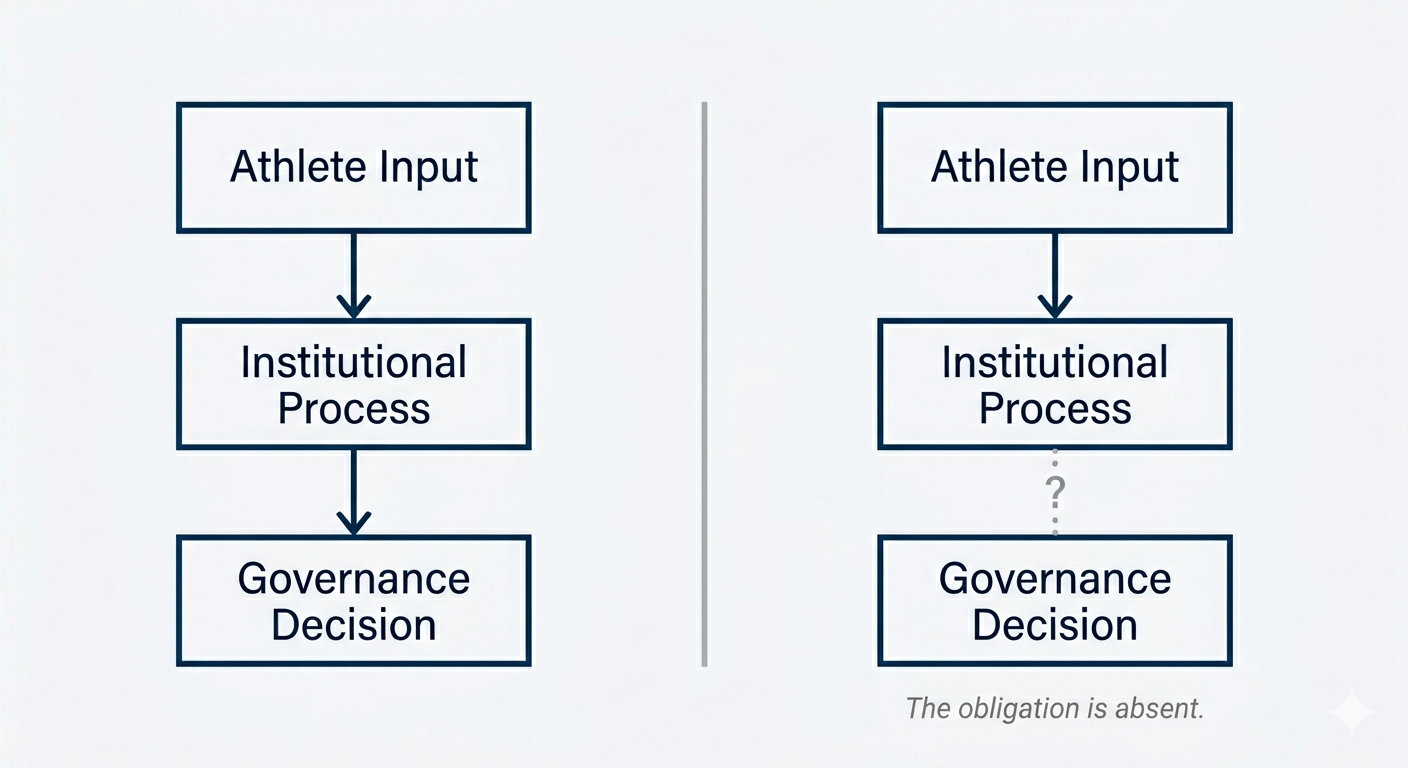
Athlete representation without decision rights is consultation, not governance. There is a structural difference. Most systems have the former.
<section>
<h2>Why This Keeps Coming Up</h2>
<p>Over the past two decades, sport governance has produced a significant volume of activity around athlete representation. The IOC established its Athletes' Commission with formal voting rights on specific matters. World Athletics published a four-year plan for its Athletes' Commission. National governing bodies across multiple countries created advisory panels, athlete councils, and athlete welfare committees. The language of "athlete voice" became standard vocabulary in governance reform documents.</p>
<p>Measured by those outputs alone, progress is real. More athletes are present in governance structures than at any previous point in sport's institutional history.<sup><a href="#n1">1</a></sup></p>
<p>These gains are quantifiable. They are also not the variables that determine governance outcomes. They are measuring the wrong thing.</p>
<p>The dominant metric has been presence: percentage of board seats held by athletes, number of athlete commission members, frequency of athlete consultation processes. Research into sport federation governance confirms what governance practitioners often observe privately: in the overwhelming majority of organisations, athletes have not been granted a share of formal decision-making power.<sup><a href="#n2">2</a></sup> The expansion of athlete representation has primarily expanded advisory presence. That is a different thing.</p>
<p>Calling advisory presence "representation" without naming the distinction has produced a measurement failure embedded in the reform narrative itself.</p>
<p>This article is about that distinction. Not as a criticism of the institutions that built these structures, but as a structural analysis of what those structures actually do.</p>
</section>
<!-- SECTION 2 -->
<section>
<h2>The Structural Difference</h2>
<p>There are two categories at stake. They are not points on a spectrum.</p>
<p><strong>Consultation</strong> is a process in which athlete input is collected, processed by management or a governing body, and incorporated into decisions at the discretion of the decision-maker. The athlete's role is to provide information or perspective. The decision authority remains with the institution.</p>
<p><strong>Governance authority</strong> is a design condition in which athlete input can produce a binding outcome. It means athletes can veto specific decisions, require a formal response, or hold enforceable rights over defined matters. The decision authority is distributed, not delegated at management's discretion.</p>
<p>These are structurally distinct. A body can have athlete representation in the formal sense and exercise no governance authority whatsoever. The formal presence and the operational authority are independent variables.</p>
<p>This is not a novel distinction. Organisational theory has documented the gap between formal authority and operational authority in corporate governance, healthcare systems, and regulatory bodies for decades.</p>
<p>In healthcare, Arnstein's Ladder of participation provides a taxonomy that runs from non-participation through tokenism to citizen power.<sup><a href="#n4">4</a></sup> Researchers applying it to healthcare patient representation structures found that most operated in the tokenism band even when formally classified as participatory. Sport governance has reproduced this pattern almost exactly, without applying the same analytical vocabulary.</p>
<p>The question is not whether athletes have representation. Most systems do. The question is where on that taxonomy their representation actually sits.</p>
</section>
<!-- SECTION 3 -->
<section>
<h2>Why the Gap Persists</h2>
<p>The gap between formal representation and governance authority persists for design reasons. It is not primarily a function of bad intent.</p>
<p>Governing bodies have rational incentives to build advisory structures rather than authority structures. An athlete commission that can produce binding recommendations creates governance risk for the institution. It distributes authority. It creates the possibility of athlete positions that management cannot override. From a pure institutional control perspective, an advisory commission is strictly preferable to a commission with decision rights.</p>
<p>This creates what we might identify as a commission-capture effect: a pattern governance research has begun to map, where advisory structures function to legitimise governance bodies' claims to athlete input without requiring any transfer of decision authority.<sup><a href="#n5">5</a></sup> The commission exists. It meets. It produces recommendations. Those recommendations enter a management process and are incorporated, modified, or set aside at the discretion of the institution. Athlete commissioners cannot independently verify whether their input shaped the outcome. There is no formal mechanism by which they could.</p>
<p>Three mechanisms sustain the gap.</p>
<div class="mechanism">
<p class="mechanism-label">Mechanism 1: The Consultation Loop</p>
<p>Athlete input is collected in structured forums, processed by staff, and returned to athletes as policy. The processing step is invisible. Athletes observe that they were consulted. They rarely observe whether their input was causally related to the output. The loop closes without producing accountability for the gap between input and outcome.<sup><a href="#n6">6</a></sup></p>
</div>
<div class="mechanism">
<p class="mechanism-label">Mechanism 2: The Homogeneity Assumption</p>
<p>Athlete commissions are typically composed of recently retired or active elite athletes from commercially prominent sports. They are asked to represent "athlete interests" as a unified category. This assumption conceals enormous governance variation. Development athletes, para athletes, and athletes outside the commercial mainstream have structurally different interests and almost no representation in commission structures that claim to speak for them.<sup><a href="#n7">7</a></sup> A commission that represents one cohort while claiming to represent all athletes simultaneously over-delivers legitimacy to the institution and under-serves the athletes not in the room.</p>
</div>
<div class="mechanism">
<p class="mechanism-label">Mechanism 3: The Formal-Operational Gap at Commission Level</p>
<p>Even where athletes hold formal board seats, those seats confer formal governance rights but not necessarily operational influence. Research on corporate minority board representation documents the same gap: formal presence does not reliably translate to operational influence on the decisions that matter unless specific conditions are met. What the evidence base supports is that access to information, coherent bloc positioning, and formal veto over defined matters are all design requirements. Sport governance has not applied these conditions to athlete commission design.</p>
</div>
</section>
<!-- SECTION 4 -->
<section>
<h2>What the Welfare Failures Reveal</h2>
<p>There is a category of evidence that is rarely framed this way in governance reform discussions.</p>
<p>The major welfare failures in sport over the past decade occurred in systems that had formal athlete representation structures. They were not governance vacuums. They had athlete advisory panels, welfare committees, and athlete consultation processes.<sup><a href="#n9">9</a></sup></p>
<p>Post-failure reviews consistently identified governance gaps. What they identified, examined structurally, was not the absence of representation. It was the absence of authority. Athletes had channels to provide input. They did not have formal mechanisms to compel a governance response. Consultation existed. Decision rights did not.</p>
<p>This is not evidence that formal representation is useless. It is evidence that formal representation is insufficient. A governance structure in which athletes can be heard but cannot compel a binding response will not catch systematic welfare failures. The information may enter the system. The system has no formal obligation to act on it.</p>
<p>That is a design feature, not an operational failure.</p>
</section>
<!-- SECTION 5 -->
<section>
<h2>The Rule</h2>
<p>If an athlete commission or representation structure cannot produce a binding outcome on at least some defined category of decisions, it is a consultation structure. It may be a valuable consultation structure. It is not a governance structure.</p>
<div class="test-block">
<p class="test-label">The Direct Test</p>
<p>Can the commission produce a decision that the governing body must implement, even if it disagrees?</p>
<p>Can the commission veto or require formal review of a defined category of decision?</p>
<p>Is there a formal mechanism by which the commission can verify that its input shaped a specific outcome?</p>
<p>Can athletes appeal a governance decision through a process that has independent standing from the body being appealed against?</p>
</div>
<p>If the answer to all four is no, the structure is advisory. Calling it governance authority is a category error.</p>
<p>This does not mean all sport governing bodies are acting in bad faith. Many have built advisory structures that function well within their design parameters. The problem is a framing problem: governance reform proposals have persistently measured progress in terms of representation presence while the actual governance question concerns the distribution of decision authority.</p>
<p>Recent legal developments are sharpening this distinction. India's National Sports Governance Rules 2026 mandate athlete representation at specific governance levels.<sup><a href="#n10">10</a></sup> The US Passing the Torch Commission recommendations include a 33% athlete representation threshold.<sup><a href="#n11">11</a></sup> These are meaningful formal interventions. They will produce more athlete presence. They will not, by design, resolve the formal-vs-operational authority gap unless the design requirements for binding athlete authority are specified alongside the representation mandates.</p>
<p>More athletes in the room does not change what happens in the room unless the room's decision architecture changes.</p>
</section>
<!-- SECTION 6 -->
<section>
<h2>What This Looks Like in Practice</h2>
<p>The questions that follow are not rhetorical. Each one has an answer visible in the governing documents of any sport federation. Most governing bodies have not looked systematically. That is the starting point.</p>
<p>For board chairs and governance leads, the practical question is whether your athlete representation structure is doing what you believe it is doing.</p>
<ul class="diagnostic">
<li>
<div>
<span class="diagnostic-q">On Decision Scope</span>
<p>Which specific decisions require athlete commission input before they can proceed? Is that requirement written into governance documents or is it convention? Convention is reversible under pressure. Governance documents are not.</p>
</div>
</li>
<li>
<div>
<span class="diagnostic-q">On Binding Outcomes</span>
<p>Can the athlete commission produce a recommendation that the board must formally respond to, with reasons, within a defined timeframe? Or does the commission produce recommendations that enter management process without a formal obligation to respond?</p>
</div>
</li>
<li>
<div>
<span class="diagnostic-q">On Information Access</span>
<p>Do athlete commissioners have access to the financial and operational information they would need to assess whether their interests are being served? Or do they receive curated summaries prepared by management?</p>
</div>
</li>
<li>
<div>
<span class="diagnostic-q">On Accountability</span>
<p>When an athlete commission recommendation was not adopted, was the commission formally notified of the reasons? Was that reasoning subject to challenge? Or did the recommendation disappear into process?</p>
</div>
</li>
<li>
<div>
<span class="diagnostic-q">On Independence</span>
<p>Can athlete commissioners raise concerns through an independent accountability channel that operates separately from the institution? Or does independence depend on individual relationships within the governing body?</p>
</div>
</li>
</ul>
<p>These are governance design choices. Each one has a visible answer in the documents that govern your organisation. Most governing bodies have not looked.</p>
</section>
<!-- SECTION 7 -->
<section>
<h2>What We Do Not Know</h2>
<p>The evidence base here is specific about what it can and cannot support.</p>
<p>It can confirm that formal athlete commission structures in the majority of federations do not confer binding decision authority. That finding is consistent across sport governance research and the participation literature from adjacent sectors.<sup><a href="#n12">12</a></sup></p>
<p>It cannot confirm that binding athlete authority improves governance outcomes in sport contexts specifically. The cross-sector analogues, healthcare and corporate co-determination, are structurally instructive, not evidential. They demonstrate that binding stakeholder participation is achievable and has produced different governance outcomes in other contexts. They do not prove that the same conditions translate directly to sport federation governance.</p>
<p>The revenue structure of athlete-funded governing bodies introduces a complication the standard representation literature does not address. In a body funded primarily by athlete licences, membership fees, or commercial revenues in which athletes are the product, athletes are simultaneously the revenue source, the governed constituency, and the nominal stakeholder the governance structure is designed to serve. The principal-agent relationship, meaning the governance dynamic between those who hold decision authority and those whose interests that authority is meant to serve, in that configuration is structurally distinct from patient representation in healthcare or employee co-determination in corporate governance. The appropriate authority design for that configuration has not been systematically examined in the governance literature. That gap is worth naming clearly.</p>
<p>The evidence base for what functional athlete commission authority looks like in practice is also thin. The governance reform literature has documented the failures and the formal structures. It has not documented many cases of athlete commission authority operating as designed, with traceable effects on binding governance outcomes. That absence may itself be informative. But it is worth being precise about what is established and what is not.</p>
</section>
<!-- SECTION 8 -->
<section>
<h2>The Rule, Compressed</h2>
<p>The argument here is not that athlete representation has failed. It is that representation has been treated as the endpoint when it is, at best, a precondition.</p>
<p>The formal-vs-operational authority gap in sport federation governance is not unique to athlete representation. Prior pieces in this series have identified the same gap between board authority and management authority, and between governance documents and funding agreements. What this piece adds is the athlete-specific dimension: the cohort with the most direct and personal stake in governance outcomes is, in most systems, the cohort with the least design authority over those outcomes.</p>
<p>That is a design choice. It is not inevitable.</p>
<p>The test is not how many athletes are in the room. It is whether anything formally different happens because they are there.</p>
<p class="signature-close">Great systems elevate people. Poor systems constrain them.</p>
</section>
<!-- ENDNOTES -->
<section class="endnotes">
<h2>Notes</h2>
<div class="caveat">
<p class="caveat-label">Editorial Note on Reference Status</p>
<p>Sources marked <span class="flag">EXTRAPOLATED</span> indicate claims that rely on cross-sector inference from adjacent evidence domains rather than directly confirmed sources in the current set. Sources marked <span class="flag">VERIFY</span> indicate primary sources requiring confirmation before publication. All other sources are from the confirmed authoritative list.</p>
</div>
<ol>
<li id="n1">IOC Athletes' Commission overview and mandate: <a href="https://www.olympics.com/ioc/athletes-commission" target="_blank">olympics.com/ioc/athletes-commission</a>. World Athletics Athletes' Commission 4-Year Plan: <a href="https://worldathletics.org/download/download?filename=eb280aa1-cd92-4af7-b33a-67685d8de1a1.pdf" target="_blank">worldathletics.org [PDF]</a>. <span class="flag">NOTE</span> The World Athletics link is a direct PDF download. Verify accessibility in publication context before publishing; consider linking to the Athletes' Commission landing page as a more stable reference.</li>
<li id="n2">Ferkins, L. et al. Athletes' Involvement in Decision Making for Good Governance in Sport: <a href="https://www.researchgate.net/publication/332473390" target="_blank">researchgate.net/publication/332473390</a>. See also: Democratization and governance in international sport: <a href="https://www.researchgate.net/publication/254304665" target="_blank">researchgate.net/publication/254304665</a>.</li>
<li id="n4">Primary source: Arnstein, S.R. (1969). A Ladder of Citizen Participation. <em>Journal of the American Institute of Planners</em>, 35(4), 216–224. <span class="flag">VERIFY — Primary source not in confirmed list; requires verification before publication.</span> Applied in healthcare governance context: NHS Framework for Patient and Public Participation in Specialised Commissioning: <a href="https://www.england.nhs.uk/long-read/framework-for-patient-and-public-participation-in-specialised-commissioning/" target="_blank">england.nhs.uk</a>. See also: Tokenism or Political Activism — Reflections on Participatory Planning: <a href="https://www.researchgate.net/publication/232921371" target="_blank">researchgate.net/publication/232921371</a>.</li>
<li id="n5">The commission-capture effect is introduced here as an analytical lens, not an established peer-reviewed term. Primary governance evidence: Democratization and governance in international sport: <a href="https://www.researchgate.net/publication/254304665" target="_blank">researchgate.net/publication/254304665</a>. Corroborating practitioner source (secondary only): <a href="https://www.sportanddev.org/latest/news/who-holds-power-sports-governance" target="_blank">sportanddev.org — Who holds power in sports governance</a>.</li>
<li id="n6">Athletes' Involvement in Decision Making for Good Governance in Sport: <a href="https://www.researchgate.net/publication/332473390" target="_blank">researchgate.net/publication/332473390</a>. Corroborating practitioner source (secondary only): <a href="https://www.sportanddev.org/latest/news/more-engagement-needed-effective-athlete-representation" target="_blank">sportanddev.org — More engagement needed for effective athlete representation</a>.</li>
<li id="n7">Understanding the Meaning of Representation in a Deliberative Democratic Governance System: <a href="https://www.researchgate.net/publication/336015517" target="_blank">researchgate.net/publication/336015517</a>. See also: Deliberative Spaces of Elite Athlete Representation in Transnational Governance: <a href="https://experts.umn.edu/en/publications/deliberative-spaces-of-elite-athlete-representation-in-transnatio-2/" target="_blank">experts.umn.edu</a>.</li>
<li id="n9">For welfare governance failure patterns in systems with formal representation structures, see: <a href="https://pmc.ncbi.nlm.nih.gov/articles/PMC8762430/" target="_blank">PMC8762430</a>; <a href="https://pmc.ncbi.nlm.nih.gov/articles/PMC9751918/" target="_blank">PMC9751918</a>; <a href="https://pmc.ncbi.nlm.nih.gov/articles/PMC11259793/" target="_blank">PMC11259793</a>. Corroborating advocacy/institutional context (secondary only): Global Athlete 2025 end-of-year message: <a href="https://www.globalathlete.org/our-word/2025-end-of-year-message" target="_blank">globalathlete.org</a>; Fair Sport 2025: <a href="https://www.fairsport.org/updates/2025-end-of-year-message" target="_blank">fairsport.org</a>.</li>
<li id="n10">India National Sports Governance Rules 2026: <a href="https://www.scconline.com/blog/post/2026/01/14/national-sports-governance-national-sports-bodies-rules-2026-explained/" target="_blank">scconline.com</a>.</li>
<li id="n11">US Olympic Reform Commission analysis: <a href="https://projectplay.org/news/olympic-reform-commission-report-analysis-next-steps" target="_blank">projectplay.org</a>.</li>
<li id="n12">Governance at the federation level: <a href="https://www.tandfonline.com/doi/full/10.1080/16184742.2023.2292102" target="_blank">tandfonline.com</a>. See also: Who holds power in sports governance: <a href="https://www.sportanddev.org/latest/news/who-holds-power-sports-governance" target="_blank">sportanddev.org</a>.</li>
</ol>
</section>