AI & Governance
5 Governance Principles That Enable High-Performance Sport Systems
This article examines why high-performance failures in sport are often governance failures in disguise. It outlines five core governance principles consistently present in high-performing sport systems: role clarity over role power, strategic alignment before performance targets, accountability that enables rather than controls, athlete-first as a decision filter, and governance that enables speed. The article also introduces two emerging principles from AI and complex systems that sport must adopt: decision traceability and data/AI stewardship as governance functions. Drawing on case studies from British Cycling, AusCycling, Sport Ireland, and governance research across sectors, it argues that sustained performance requires designing better decisions, not finding better people.
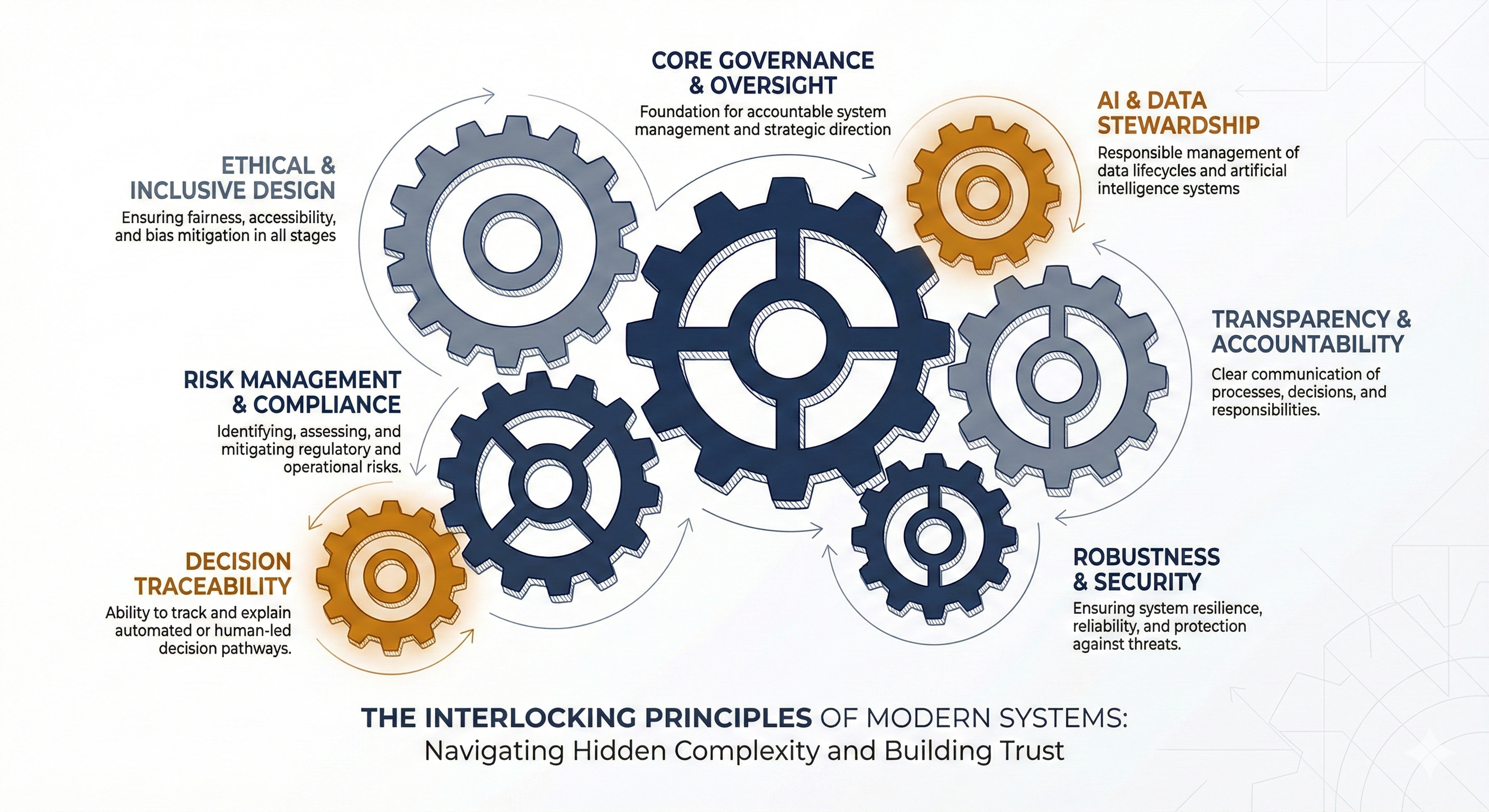
<h2>5 Governance Principles That Enable High-Performance Systems (Sport) + 2 Emerging Principles (AI & Data)</h2>
<p>Most high-performance failures in sport aren't technical problems.</p>
<p>They're governance failures disguised as performance issues.</p>
<p>The organisations that sustain performance don't govern harder — they govern <em>differently</em>.</p>
<p>Here's the truth: the next major crisis in sport won't come from a failed drug test or a tactical error on the field. It'll come from a boardroom that couldn't make decisions fast enough, couldn't trace why choices were made, or couldn't protect the people it was built to serve.</p>
<p>We've seen it before.</p>
<p>British Cycling dominated the Olympic podium for years — then the Independent Review Panel pulled back the curtain. What they found wasn't a coaching problem. It was a governance breakdown.</p>
<p>A power vacuum at the top. Demoralised athletes and staff. A culture of fear where people were afraid to speak up. And a system that celebrated medalists while abandoning everyone else.</p>
<p>The "medals at all costs" culture didn't just prioritise outcomes over systems — it prioritised funding over people, performance over welfare, and reputation over truth. The warning signs were everywhere. Complaints were filed. Concerns were raised. Culture reports documented the problems.</p>
<p>They just weren't prioritised.</p>
<p>Why?</p>
<p>Because the governance structures weren't designed to handle them.</p>
<p>The truth is, <strong>great systems elevate people. Poor systems constrain them.</strong></p>
<p>And most sport organisations are still operating with governance models built for stability, not performance. They're designed to protect reputation, not enable speed. They reward control, not clarity. And when pressure hits — funding cuts, selection controversies, safeguarding failures — those systems collapse.</p>
<p>But some organisations don't collapse.</p>
<p>They adapt. They learn. They perform under pressure because their governance <em>enables</em> it.</p>
<p>This article outlines <strong>five governance principles</strong> consistently present in high-performing sport systems — and <strong>two critical principles</strong> borrowed from AI, data, and complex systems that sport hasn't caught up to yet.</p>
<p>But must.</p>
<hr>
<h2>The 5 Core Governance Principles (Sport-Embedded)</h2>
<h3>1. Role Clarity Over Role Power</h3>
<p>When everyone has authority, no one has accountability.</p>
<p>Most performance bottlenecks aren't people problems — they're <strong>role problems</strong>.</p>
<p>Here's what happens in unclear systems:</p>
<ul>
<li>Boards drift into operational decisions</li>
<li>Executives second-guess strategic direction</li>
<li>High-performance staff work <em>around</em> governance instead of <em>with</em> it</li>
</ul>
<p>Sport Ireland's governance framework makes this explicit: boards are responsible for <strong>strategic direction, values, and oversight</strong> — not day-to-day operations. That's management's job. The separation matters because when roles blur, decisions slow down, politics accelerate, and performance suffers.</p>
<p>Sport New Zealand goes further. They position the board at the <strong>strategic level</strong>, setting goals and objectives while ensuring management understands them. Not micromanaging them. Not doing the work for them.</p>
<p>The best part?</p>
<p>Clarity reduces politics. And politics kill performance.</p>
<p>The <strong>Sport Information Resource Centre (SIRC)</strong> in Canada studied high-performing sport boards and found something simple but critical: effectiveness improves when <strong>authorities, accountabilities, and reporting standards</strong> are clearly documented. When people know who decides what, they stop fighting over territory and start delivering results.</p>
<p>But here's where it gets real.</p>
<p>The National Governance Association in the UK studied multi-academy trusts and found that <strong>unclear roles between boards and executives create tension and weaken decision-making</strong>. Sound familiar? It should. Because the same thing happens in sport organisations every single day.</p>
<p><strong>The takeaway?</strong></p>
<p>Role clarity isn't about limiting people. It's about <strong>unleashing</strong> them. When people know their lane, they move faster. When decision rights are explicit, bottlenecks disappear.</p>
<p>And performance follows.</p>
<hr>
<h3>2. Strategic Alignment Before Performance Targets</h3>
<p>You can't chase outcomes your system isn't built to deliver.</p>
<p>Medals don't fail systems — misalignment does.</p>
<p>Let me show you what I mean.</p>
<p>British Cycling won medals. Lots of them. Olympic cycle after Olympic cycle. But beneath the podium finishes, the system was disintegrating. Management structures were breaking down. Cultural issues were escalating. Athlete welfare concerns were being ignored.</p>
<p>The Independent Review Panel said it clearly: the <strong>overemphasis on outcomes (medals, funding) without structural and cultural alignment</strong> contributed directly to governance failure.</p>
<p>The BBC reported it even more bluntly: a "money for medals" ethos led to behavioural and cultural warning signs being <strong>deprioritised</strong>. Because if the medals kept coming, who cared about the system?</p>
<p>Until the system broke.</p>
<p>And when it broke, it broke publicly. Painfully. Expensively.</p>
<p>Here's the pattern: <strong>targets without alignment create performance debt.</strong> You can mask it for a while — sometimes for years — but eventually, the bill comes due. And it's always higher than you think.</p>
<p>AusCycling learned this the hard way after an equipment failure at the Tokyo 2020 Olympics. Their response? They didn't just tighten performance targets. They created a <strong>High-Performance Review sub-committee</strong> to ensure structure, people, resources, and relationships were <strong>aligned to programme goals</strong>.</p>
<p>Alignment first. Outcomes second.</p>
<p>Kearney's research on agile governance backs this up. They argue that decisions must be <strong>designed around strategic priorities</strong>, not isolated performance indicators. Because when you optimise for the wrong thing, you get the wrong result.</p>
<p>The truth is, if your system isn't ready, ambition becomes theatre.</p>
<p>And athletes pay the price.</p>
<hr>
<h3>3. Accountability That Enables (Not Controls)</h3>
<p>Fear-based accountability doesn't prevent failure — it delays it.</p>
<p>If mistakes are punished, risks get hidden.</p>
<p>This is where most governance models break down. They confuse accountability with <strong>control</strong>. They think oversight means policing. And they create cultures where people are afraid to be honest, afraid to experiment, and afraid to raise concerns.</p>
<p>The result?</p>
<p>Decisions slow down. Innovation stops. And when something goes wrong, no one saw it coming — because no one felt safe enough to say it out loud.</p>
<p>INSEAD studied this. Their research on psychological safety in boardrooms found that boards with <strong>high psychological safety</strong> exhibit greater effectiveness, creativity, learning, and resilience. But — and this is critical — safety must be balanced with <strong>clear expectations and accountability</strong> to avoid complacency.</p>
<p>It's not safety <em>or</em> accountability.</p>
<p>It's safety <em>and</em> accountability.</p>
<p>The Boardroom Psychological Safety Index (2025) reported that boards fostering psychological safety rate themselves as <strong>more effective</strong> in strategic and cultural decision-making. They experience fewer psychosocial hazards. Fewer biases. Better outcomes.</p>
<p>Why?</p>
<p>Because people speak up. They challenge assumptions. They learn from mistakes instead of hiding them.</p>
<p>The Australian Commission on Safety and Quality in Health Care puts it this way: governing bodies are responsible for setting <strong>organisational culture and behavioural standards</strong> that support purpose and strategy. Not punitive control. Not fear-based compliance.</p>
<p>Standards that enable.</p>
<p>Youmanage (2022) says it even more directly: accountability must be paired with <strong>empowerment</strong> — tools, skills, and support. Otherwise, "it sets people up to fail."</p>
<p>Think about your own organisation.</p>
<p>Are your people empowered to make decisions? Or are they waiting for permission?</p>
<p>Are mistakes treated as learning opportunities? Or career risks?</p>
<p>Because the best systems hold people accountable <strong>without making them defensive</strong>.</p>
<p>And that's a governance design choice.</p>
<hr>
<h3>4. Athlete-First as a Decision Filter (Not a Value Statement)</h3>
<p>Values don't protect athletes. Structures do.</p>
<p>Here's the uncomfortable truth: most sport organisations say they're "athlete-first." It's in their vision statements. Their brand guidelines. Their funding applications.</p>
<p>But when the pressure hits — when funding is on the line, when selection gets political, when reputational risk appears — <strong>athlete-first collapses</strong>.</p>
<p>Why?</p>
<p>Because it was never designed to survive pressure. It was a value. Not a <strong>decision filter</strong>.</p>
<p>British Cycling's Independent Review Panel found that the central pursuit of medals and funding led to <strong>cultural and behavioural issues not being prioritised</strong>. Athlete welfare concerns were raised. Complaints were filed. Culture reports were written.</p>
<p>And nothing changed.</p>
<p>Because the governance structures didn't require it to change. There was no decision filter that said: "If this decision harms athletes, we don't make it."</p>
<p>The BBC coverage of the scandal was blunt: "winning at all costs" concerns sparked debate about <strong>balancing medals and welfare</strong>. But debate isn't governance. Debate is what happens when structures fail.</p>
<p>AusCycling offers a better model. After their Tokyo 2020 equipment investigation, they didn't just fix the handlebars. They adopted <strong>all recommendations</strong> from the independent review and created structures to improve <strong>safety and performance readiness</strong>.</p>
<p>Athlete-first became structural. Not aspirational.</p>
<p>Sport Ireland's guidance reinforces this. Boards should determine <strong>core values and ethical frameworks</strong> — which includes safeguarding and athlete welfare as <strong>central governance responsibilities</strong>, not peripheral compliance issues.</p>
<p>The National Governance Association (UK) shows this in an education context. Boards must direct resources to areas of greatest need in pursuit of their vision <strong>for children</strong>. It's a child-first lens — structurally analogous to athlete-first in sport.</p>
<p>Here's the test:</p>
<p>When your funding model depends on athlete contributions (which it does for many smaller or growing organisations), does your governance protect those athletes from exploitation? Or does it optimise for survival?</p>
<p>When selection becomes contentious, do you have documented criteria? Transparent processes? Appeal mechanisms?</p>
<p>When reputational risk appears, do you protect the institution or the person?</p>
<p>Athlete-first only works when it's embedded in <strong>decision-making structures</strong> — not just culture decks.</p>
<hr>
<h3>5. Governance That Enables Speed</h3>
<p>Your system isn't slow. Your decisions are.</p>
<p>Good governance should make performance <strong>faster</strong>, not safer.</p>
<p>Let me say that again: speed is not recklessness. It's a <strong>governance outcome</strong>.</p>
<p>High-performance environments demand fast decisions. Selection windows are short. Funding cycles are tight. Injury decisions are urgent. Opportunity windows close.</p>
<p>And yet, most governance structures are designed to <strong>slow things down</strong>.</p>
<p>Committees. Approvals. Escalations. Reviews.</p>
<p>By the time a decision gets made, the moment has passed.</p>
<p>Kearney's research on agile governance is clear: effective governance creates <strong>decision-making structures</strong> that focus on the most critical decisions, allocate clear accountabilities, and provide timely information so organisations can make the <strong>right decisions at the right time</strong>.</p>
<p>Not next week. Not after the next board meeting.</p>
<p>At the right time.</p>
<p>Agile Digest (2024) explains that agile governance <strong>distributes decision-making roles</strong> and emphasises informed, collaborative decisions. This enables faster responses while maintaining necessary oversight.</p>
<p>The key word? <strong>Distributes</strong>.</p>
<p>Most sport governance models centralise decisions. Everything escalates to the board. Or the CEO. Or the high-performance director. And the system grinds to a halt.</p>
<p>The alternative is <strong>subsidiarity</strong> — decisions made at the lowest competent level. If a coach can make the call, let them. If a performance analyst can approve the budget, let them. If an athlete welfare officer can escalate a concern directly, let them.</p>
<p>Speed doesn't come from removing oversight.</p>
<p>It comes from <strong>designing decision rights</strong> so oversight happens at the right level.</p>
<p>Sport New Zealand reinforces this. They emphasise that boards must focus on <strong>strategy and clear objectives</strong> while leaving implementation to management. This prevents boards from clogging day-to-day decision pathways.</p>
<p>Think about it.</p>
<p>How many decisions in your organisation are waiting for approval that could already be made?</p>
<p>How many opportunities have you missed because the governance process was too slow?</p>
<p>Because here's the reality: slow decisions cost cycles. And in high-performance sport, you don't get those cycles back.</p>
<hr>
<h2>The 2 Missing Principles (Non-Traditional, High Impact)</h2>
<p>These principles are standard in AI, aviation, defence, and complex systems.</p>
<p>And they're largely absent in sport.</p>
<p>But not for long.</p>
<hr>
<h3>6. Decision Traceability (Explainability Over Hindsight)</h3>
<p>Most governance failures aren't bad decisions — they're undocumented ones.</p>
<p>If you can't explain the decision, you can't learn from it.</p>
<p>Here's the problem: sport organisations make thousands of decisions every year. Selection decisions. Funding decisions. Staffing decisions. Welfare decisions. Strategy decisions.</p>
<p>And most of them are never documented.</p>
<p>Not the reasoning. Not the criteria. Not the trade-offs. Not the alternatives considered.</p>
<p>So when something goes wrong — when a selection blows up, when a safeguarding failure emerges, when funding gets pulled — no one can reconstruct <strong>why</strong> the decision was made.</p>
<p>They can only point fingers.</p>
<p>FlexRule (2025) outlines a decision governance approach where decisions are <strong>modelled, executed, and monitored</strong> with explicit documentation of inputs, criteria, and workflows. They stress transparency, traceability, and auditability as prerequisites for <strong>trusted and explainable decisions</strong>.</p>
<p>Aptus Data Labs (2025) goes further. They describe AI audit trails as <strong>detailed records</strong> of inputs, outputs, model behaviour, and decision logic. This traceability underpins accountability, compliance, and the ability to <strong>investigate failures</strong> — so you can learn instead of blame.</p>
<p>VerifyWise AI defines auditability as the ability to trace <strong>how decisions are made, what data is used, and how outputs are managed</strong>. It positions audit-ready systems as a governance objective that enables <strong>ex-post review and organisational learning</strong>.</p>
<p>Think about your last controversial selection decision.</p>
<p>Can you explain why it was made? What criteria were applied? What data informed it? What alternatives were considered?</p>
<p>Or would you be reconstructing the story after the fact?</p>
<p>Because outcomes are judged later. But reasoning must be captured <strong>earlier</strong>.</p>
<p>8allocate (2025) argues that governance is incomplete without traceability. They call for <strong>audit logs and structured approval workflows</strong> so every decision has a lifecycle record. This enables accountability and problem diagnosis when issues arise.</p>
<p>Sport New Zealand touches on this indirectly. They stress the board's role in requiring <strong>clear goals, strategies, and reporting</strong> — which, in practice, means decisions and results must be documented and monitored in a way that can be traced back to board intent.</p>
<p>The truth is, traceability reduces politics. It enables learning. And it protects leaders and athletes when outcomes disappoint.</p>
<p>Because if you can show your reasoning was sound, the outcome becomes a data point — not a crisis.</p>
<hr>
<h3>7. Data & AI Stewardship as a Governance Function</h3>
<p>If AI informs selection, governance is already involved — whether it admits it or not.</p>
<p>It's "just data" until trust disappears.</p>
<p>Here's what's happening right now in sport:</p>
<p>AI models are being used for <strong>talent identification</strong>. Injury risk prediction. Performance monitoring. Load management. Classification decisions.</p>
<p>Data is being collected on athletes' bodies, movements, sleep, nutrition, mental health, biometrics.</p>
<p>Algorithms are influencing <strong>selection, funding, and monitoring</strong>.</p>
<p>And in most organisations, this is treated as a <strong>technical issue</strong> — not a governance one.</p>
<p>That's a mistake.</p>
<p>The Harvard Law School Forum on Corporate Governance (2022) is clear: directors are best placed to ensure companies reap AI's benefits while avoiding harms and litigation risks. <strong>Responsible AI deployment falls squarely within the board's fiduciary duties</strong>.</p>
<p>The Corporate Governance Institute (2025) goes further. They state that boards must ensure a <strong>clear AI governance framework</strong>, manage AI risks (bias, security, compliance), and maintain clear lines of accountability for AI development and deployment.</p>
<p>EuroMaTech (2025) highlights that boards must prioritise <strong>responsible AI frameworks</strong>, set boundaries for AI use, and establish oversight mechanisms to ensure automated decisions align with <strong>legal and ethical standards</strong> — including clear accountability for AI failures.</p>
<p>Let me make this real.</p>
<p>If your organisation uses an algorithm to identify talent, and that algorithm has bias — gender, race, socioeconomic — who's accountable when trust collapses?</p>
<p>If your performance monitoring system collects athlete biometric data, and that data is breached or misused, who answers for it?</p>
<p>If your selection model prioritises certain performance markers over others, and athletes lose funding as a result, can you explain why those markers were chosen?</p>
<p>Aptus Data Labs (2025) explains that responsible AI depends on <strong>auditability, explainability, data privacy, and human oversight</strong>. These aren't technical controls. They're <strong>governance controls</strong>.</p>
<p>And governance bodies must design and monitor them.</p>
<p>The Corporate Governance Institute reinforces this: ultimate accountability for AI rests with the <strong>board</strong>, which must treat ethical outcomes of AI systems as key performance indicators.</p>
<p>Here's the reality: most sport organisations don't even have a data governance policy. Let alone an AI ethics framework.</p>
<p>But data and AI are already performance assets.</p>
<p>And ethical risks.</p>
<p>And if governance doesn't own the stewardship of those assets, someone else will — usually after something goes wrong.</p>
<hr>
<h2>The Synthesis</h2>
<p>High-performance governance is not about more rules. More committees. More control.</p>
<p>It's about <strong>decision design</strong>. Clarity under pressure. And systems that <strong>learn faster than they fail</strong>.</p>
<p>The organisations that sustain performance don't govern harder.</p>
<p>They govern <strong>differently</strong>.</p>
<p>They design governance that:</p>
<ul>
<li><strong>Clarifies roles</strong> so people move faster</li>
<li><strong>Aligns systems</strong> before chasing outcomes</li>
<li><strong>Enables accountability</strong> without fear</li>
<li><strong>Embeds athlete-first</strong> in decision structures</li>
<li><strong>Accelerates decisions</strong> instead of delaying them</li>
<li><strong>Traces reasoning</strong> so they can learn</li>
<li><strong>Stewards data and AI</strong> as governance responsibilities</li>
</ul>
<p>And the truth is, you don't need better people.</p>
<p>You need <strong>better decisions</strong> — by design.</p>
<hr>
<h2>What's Next?</h2>
<p>If you're reading this and wondering where your organisation sits on this spectrum, you're not alone.</p>
<p>Most sport organisations know their governance could be stronger. They just don't know <strong>where to start</strong>.</p>
<p>That's why we built the <strong>HP Systems Readiness Scorecard</strong>.</p>
<p>It's a diagnostic tool that evaluates your organisation's current position across the principles outlined in this article — and gives you a <strong>personalised recommendation</strong> based on where you are and where you need to go.</p>
<p>No generic advice. No one-size-fits-all framework.</p>
<p>Just clarity.</p>
<p>Because great systems elevate people. Poor systems constrain them.</p>
<p>And if you're going to build systems that perform under pressure, you need to know where the gaps are.</p>
<p><strong>👉 <a href="your-link-here">Take the HP Systems Readiness Scorecard</a> and get your personalised governance roadmap.</strong></p>
<hr>
<h2>References:</h2>
<ol>
<li>Independent Review Panel (2017). <em>Report of the Independent Review Panel: British Cycling</em>. Available at: <a href="https://www.sportsthinktank.com/uploads/cycling-independent-review.pdf">https://www.sportsthinktank.com/uploads/cycling-independent-review.pdf</a></li>
<li>BBC Sport (2017). <em>British Cycling 'lacked good governance', says report into culture</em>. Available at: <a href="https://www.bbc.co.uk/sport/cycling/39811492">https://www.bbc.co.uk/sport/cycling/39811492</a></li>
<li>Sport Ireland (2011). <em>Board composition, roles and powers</em>. Available at: <a href="https://www.sportireland.ie/news/board-composition-roles-and-powers">https://www.sportireland.ie/news/board-composition-roles-and-powers</a></li>
<li>Sport New Zealand (n.d.). <em>The Board's Role in Strategic Planning</em>. Available at: <a href="https://sportnz.org.nz/media/t0zhtqna/the-board-s-role-in-strategic-planning.pdf">https://sportnz.org.nz/media/t0zhtqna/the-board-s-role-in-strategic-planning.pdf</a></li>
<li>SIRC Canada (2025). <em>Gold medal governance: Understanding and optimising the role of the board</em>. Available at: <a href="https://sirc.ca/articles/optimizing-the-role-of-the-board/">https://sirc.ca/articles/optimizing-the-role-of-the-board/</a></li>
<li>SIRC Canada (2025). <em>The Board, the Chair, and the CEO: Role clarification within sport governance</em>. Available at: <a href="https://sirc.ca/articles/role-clarification-sport-governance/">https://sirc.ca/articles/role-clarification-sport-governance/</a></li>
<li>National Governance Association UK (2021). <em>Charting the course to good governance</em>. Available at: <a href="https://www.nga.org.uk/media/iugnxhkx/erg-report-publication-final.pdf">https://www.nga.org.uk/media/iugnxhkx/erg-report-publication-final.pdf</a></li>
<li>AusCycling (2022). <em>Tokyo 2020 Olympic Games handlebar investigation findings</em>. Available at: <a href="https://auscycling.org.au/news/auscycling-statement-tokyo-2020-olympic-games-handlebar-investigation-findings">https://auscycling.org.au/news/auscycling-statement-tokyo-2020-olympic-games-handlebar-investigation-findings</a></li>
<li>Kearney (2010s). <em>Agile Governance: Making the Right Decisions at the Right Time</em>. Available at: <a href="https://www.kearney.com/documents/291362523/291368109/Agile+Governance-Making+the+Right+Decisions+at+the+Right+Time.pdf">https://www.kearney.com/documents/291362523/291368109/Agile+Governance-Making+the+Right+Decisions+at+the+Right+Time.pdf</a></li>
<li>INSEAD (2025). <em>When Psychological Safety Has a Seat on the Board</em>. Available at: <a href="https://knowledge.insead.edu/leadership-organisations/when-psychological-safety-has-seat-board">https://knowledge.insead.edu/leadership-organisations/when-psychological-safety-has-seat-board</a></li>
<li>People Plus Science (2025). <em>Boardroom Psychological Safety Index 2025</em>. Available at: <a href="https://www.onboardmeetings.com/wp-content/uploads/2025/08/FULL-REPORT-THE-BOARDROOM-PSYCHOLOGICAL-SAFETY-INDEX-2025-NEUROSCIENC.pdf">https://www.onboardmeetings.com/wp-content/uploads/2025/08/FULL-REPORT-THE-BOARDROOM-PSYCHOLOGICAL-SAFETY-INDEX-2025-NEUROSCIENC.pdf</a></li>
<li>Youmanage (2022). <em>How Can We Make Accountability and Empowerment Go Hand-in-Hand?</em> Available at: <a href="https://youmanage.co.uk/accountability-and-empowerment/">https://youmanage.co.uk/accountability-and-empowerment/</a></li>
<li>Agile Digest (2024). <em>Agile Governance Frameworks: Balancing Flexibility and Control</em>. Available at: <a href="https://transformation.agiledigest.com/agile-governance-frameworks/">https://transformation.agiledigest.com/agile-governance-frameworks/</a></li>
<li>FlexRule (2025). <em>Decision Governance</em>. Available at: <a href="https://www.flexrule.com/articles/decision-governance/">https://www.flexrule.com/articles/decision-governance/</a></li>
<li>Aptus Data Labs (2025). <em>The Rise of AI Audit Trails: Ensuring Traceability in Decision-Making</em>. Available at: <a href="https://www.aptusdatalabs.com/thought-leadership/the-rise-of-ai-audit-trails-ensuring-traceability-in-decision-making">https://www.aptusdatalabs.com/thought-leadership/the-rise-of-ai-audit-trails-ensuring-traceability-in-decision-making</a></li>
<li>VerifyWise AI (2025). <em>Auditability of AI systems – Lexicon</em>. Available at: <a href="https://verifywise.ai/lexicon/auditability-of-ai-systems">https://verifywise.ai/lexicon/auditability-of-ai-systems</a></li>
<li>8allocate (2025). <em>AI Content Quality Education Governance: Style, Plagiarism, Traceability, Controls</em>. Available at: <a href="https://8allocate.com/blog/ai-content-quality-education-governance-style-plagiarism-traceability-controls/">https://8allocate.com/blog/ai-content-quality-education-governance-style-plagiarism-traceability-controls/</a></li>
<li>Harvard Law School Forum on Corporate Governance (2022). <em>Board Responsibility for Artificial Intelligence Oversight</em>. Available at: <a href="https://corpgov.law.harvard.edu/2022/01/05/board-responsibility-for-artificial-intelligence-oversight/">https://corpgov.law.harvard.edu/2022/01/05/board-responsibility-for-artificial-intelligence-oversight/</a></li>
<li>Corporate Governance Institute (2025). <em>What is responsible AI?</em> Available at: <a href="https://www.thecorporategovernanceinstitute.com/insights/lexicon/what-is-responsible-ai/">https://www.thecorporategovernanceinstitute.com/insights/lexicon/what-is-responsible-ai/</a></li>
<li>EuroMaTech (2025). <em>Role of AI in Corporate Governance and Board Oversight</em>. Available at: <a href="https://www.euromatech.com/articles/role-of-ai-in-corporate-governance-and-board-oversight/">https://www.euromatech.com/articles/role-of-ai-in-corporate-governance-and-board-oversight/</a></li>
</ol>